PCB panelization is widely used in electronics manufacturing to improve production efficiency. Instead of producing individual boards separately, multiple PCBs are grouped together into a larger panel during fabrication and assembly.
Panelization provides several advantages:
- Higher manufacturing efficiency
- improved assembly automation
- reduced production cost
- easier handling during fabrication
However, poor panel design can lead to problems such as board warpage, depanelization damage, and assembly misalignment.
Understanding PCB panelization design guidelines helps engineers ensure that boards are manufactured and assembled efficiently.
Innehållsförteckning
What Is PCB Panelization?
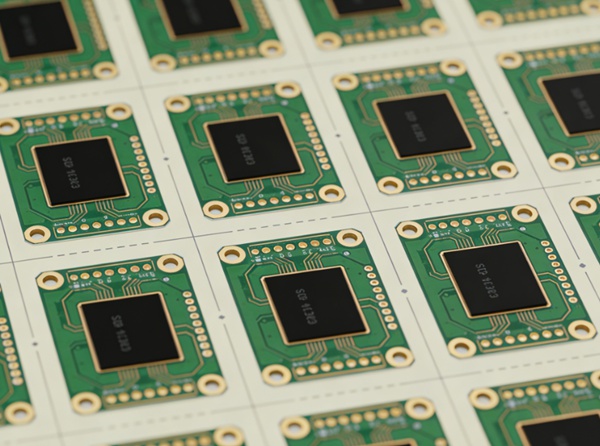
PCB panelization is the process of arranging multiple PCB designs into a larger panel for fabrication.
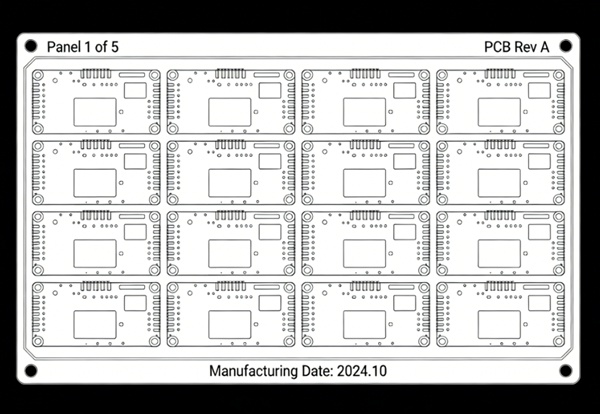
A typical PCB production panel may contain:
- several identical boards
- different board designs
- test coupons and tooling areas
After assembly, the boards are separated from the panel using depanelization methods.
The complete PCB fabrication workflow is explained in: Förklaring av tillverkningsprocessen för mönsterkort
Why PCB Panelization Is Important
Panelization improves both manufacturing efficiency och assembly reliability.
Key benefits include:
Efficient PCB fabrication
Processing larger panels increases throughput and reduces setup time.
Improved assembly automation
Pick-and-place machines handle panels more easily than individual boards.
Reduced handling damage
Panels provide mechanical stability during assembly processes such as solder paste printing and reflow.
Lower manufacturing cost
Panelization maximizes material utilization and reduces waste.
The relationship between manufacturing efficiency and cost is discussed in: Hur man sänker kostnaden för mönsterkort utan att kompromissa med kvaliteten
Common PCB Panelization Methods
Different panelization methods are used depending on board geometry and production requirements.
V-Cut (V-Score) Panelization
V-cut panelization uses shallow V-shaped grooves along board edges.
Kännetecken:
- Boards remain connected during assembly
- separation occurs after assembly
- suitable for rectangular boards
Fördelar:
- simple design
- lower fabrication cost
Begränsningar:
- not suitable for irregular board shapes
Tab Routing Panelization
Tab routing uses small breakaway tabs to connect boards within the panel.
Funktioner:
- Routed edges define board outlines
- Small tabs hold boards in place
- mouse-bite perforations assist separation
Fördelar:
- supports complex board shapes
- flexible panel layouts
Solid Rail Panelization
Some panels include additional rails along the edges.
Rails are used for:
- conveyor transport
- placement machine gripping
- fiducial placement
Assembly rails are removed after manufacturing.
PCB Panel Size Guidelines
Panel size depends on both fabrication equipment and assembly machines.
Typical panel sizes:
| Panel Type | Typisk storlek |
|---|---|
| Standard PCB panel | 18 × 24 inches |
| Smaller production panels | 12 × 18 inches |
Panel sizes should align with manufacturer capabilities.
Board Spacing in Panel Design
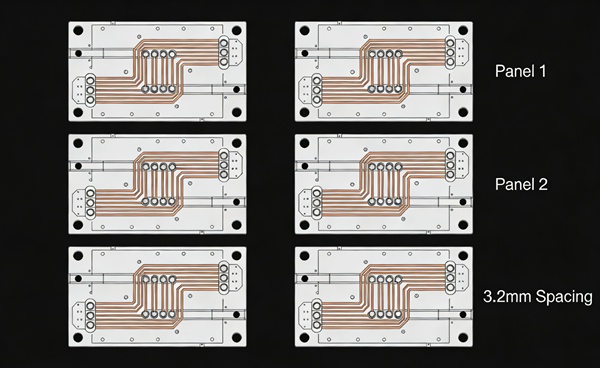
Spacing between boards is required for routing tools or V-cuts.
Typical guidelines:
V-cut spacing: 0 mm (shared edge)
Tab routing spacing: 2–3 mm
Adequate spacing prevents mechanical damage during depanelization.
Tooling Holes and Fiducial Marks
Panelization must include reference features for assembly equipment.
Tooling holes
Used for mechanical alignment during assembly.
Typical guidelines:
- 3 mm diameter holes
- located near panel corners
Fiducial marks
Used by pick-and-place machines for optical alignment.
Types:
- global fiducials (panel level)
- local fiducials (component area)
Proper alignment improves placement accuracy.
How to Design a PCB Panel (Step-by-Step)
Engineers typically follow a structured process when creating panel layouts.
- Step 1 — Determine production volume
Low-volume prototypes may not require complex panelization.
- Step 2 — Choose panelization method
Select V-cut or tab routing based on board shape.
- Step 3 — Define panel rails
Add rails if assembly equipment requires additional support.
- Step 4 — Place fiducials and tooling holes
Ensure machines can align the panel accurately.
- Steg 5 - Utför DFM-kontroller
Manufacturers verify that panel layouts are compatible with fabrication equipment.
The DFM review process is explained in: Checklista för PCB DFM innan Gerber-filer skickas
Common PCB Panelization Mistakes
Several common design errors can affect manufacturing efficiency.
Panels without assembly rails
Some automated assembly systems require rails for conveyor transport.
Insufficient spacing between boards
Boards may crack during depanelization.
Missing fiducial marks
Placement machines may experience alignment errors.
Weak breakaway tabs
Panels may break prematurely during assembly handling.
Tillverkningsaspekter
PCB manufacturers usually review panel layouts during CAM engineering analysis.
De utvärderar:
- panel dimensions
- board spacing
- depanelization methods
- rail design
- fiducial placement
At PCB manufacturers such as TOPFAST, panelization designs are often optimized during the engineering review stage to improve both fabrication efficiency and assembly reliability.
Slutsats
PCB panelization is an important step that connects PCB design with manufacturing and assembly processes.
By following panelization design guidelines—such as appropriate panel sizes, spacing rules, and breakaway methods—engineers can significantly improve production efficiency and reduce manufacturing risks.
Proper panel design also ensures compatibility with automated assembly systems and helps maintain consistent production quality.
VANLIGA FRÅGOR
A: PCB panelization is the process of combining multiple circuit boards into a single panel for fabrication and assembly.
A: V-cut uses grooves along board edges for separation, while tab routing connects boards using breakaway tabs with perforations.
A: Fiducial marks help automated assembly machines align the panel accurately during component placement.
A: For tab routing, spacing is typically 2–3 mm, while V-cut panels may share edges with minimal spacing.