PCB failure analysis is the process of identifying why a printed circuit board fails and determining the underlying root causes.
Unlike routine inspection or testing, failure analysis focuses on understanding failure mechanisms, especially those that appear after environmental stress or long-term operation.
This hub page provides a structured overview of PCB failure analysis and links to in-depth technical articles for each major failure type and analysis method.
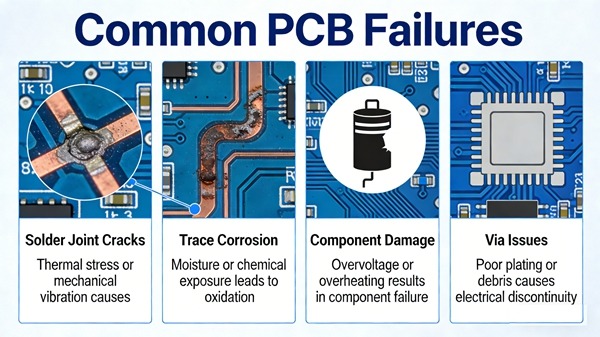
Table of Contents
Why PCB Failure Analysis Matters
Failure analysis is essential when:
- Failures are intermittent or delayed
- PCBs fail after environmental exposure
- Similar failures occur across multiple builds
- Standard inspection finds no visible defects
Effective failure analysis reduces repeat failures and improves long-term reliability.
Quality context:
PCB Quality & Reliability Explained
Common PCB Failure Types
PCB failures are rarely random. Most follow recognizable patterns.
Typical Failure Categories
- Electrical opens and shorts
- Structural and mechanical failures
- Insulation breakdown
- Environmental degradation
Detailed overview:
Common PCB Failures: Causes and Solutions
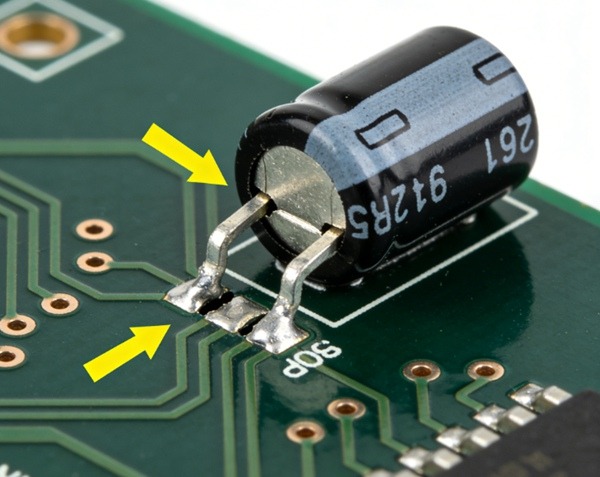
Delamination Failures
Delamination is the separation of internal PCB layers, often triggered by thermal or moisture stress.
Why It Matters
- Weakens mechanical integrity
- Enables secondary failures
- Is usually irreversible
In-depth article:
PCB Delamination: Causes and Prevention
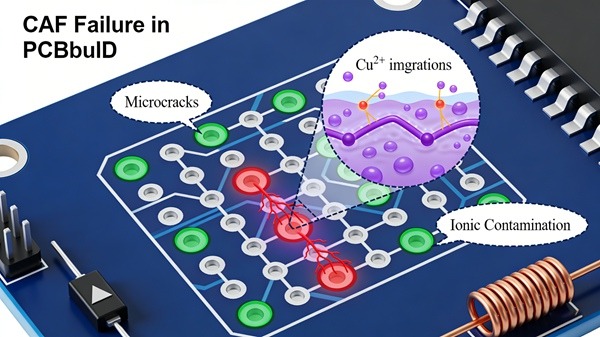
CAF (Conductive Anodic Filament) Failures
CAF is a latent failure that develops over time under moisture and electrical bias.
Key Characteristics
- Invisible during initial inspection
- Progressive insulation breakdown
- Often appears in high-density designs
Technical explanation:
CAF Failure in PCB Explained
Via Cracks and Barrel Cracks
Via cracks compromise electrical continuity under thermal cycling.
Why They Are Critical
- Often intermittent
- Difficult to detect early
- Common in multilayer PCBs
Failure mechanism:
Cracked Vias and Barrel Cracks in PCB
PCB Failure Analysis Methods
Understanding failure requires structured analysis techniques.
Common Analysis Tools
- Electrical analysis
- X-ray inspection
- Cross-sectioning
- Thermal and environmental stress testing
Methods overview:
PCB Failure Analysis Methods Explained
Failure Analysis vs Inspection and Testing
| Aspect | Failure Analysis | Inspection & Testing |
|---|---|---|
| Purpose | Root cause identification | Defect detection |
| Timing | After failure | During production |
| Methods | Destructive & non-destructive | Mostly non-destructive |
| Outcome | Process improvement | Quality control |
Inspection context:
PCB Inspection & Testing Explained
Linking Failure Analysis to Manufacturing Improvement
Failure analysis findings should be fed back into:
- Design rule optimization
- Material selection
- Process parameter control
- Inspection strategy adjustment
Manufacturers like TOPFAST treat failure analysis as part of continuous improvement, not just post-failure investigation.
When Failure Analysis Is Most Valuable
Failure analysis is especially important for:
- High-reliability electronics
- Multilayer and HDI PCBs
- New designs or materials
- Harsh operating environments
In these cases, early failure analysis prevents costly field issues.
Conclusion
PCB failure analysis provides insight into how and why failures occur, enabling better design, manufacturing, and reliability decisions.
By understanding common failure modes and applying structured analysis methods, manufacturers can significantly reduce repeat failures and improve PCB performance over time.
This hub page serves as the central reference for the PCB Failure Analysis knowledge cluster.
PCB Failure Analysis FAQ
A: Primarily yes, but it also supports process improvement.
A: No. It is applied when risk or failure justifies it.
A: It helps reduce risk but cannot predict all outcomes.
A: Some methods are, but non-destructive steps are used first.
A: Failure analysis explains failures; reliability testing stresses boards to reveal them.