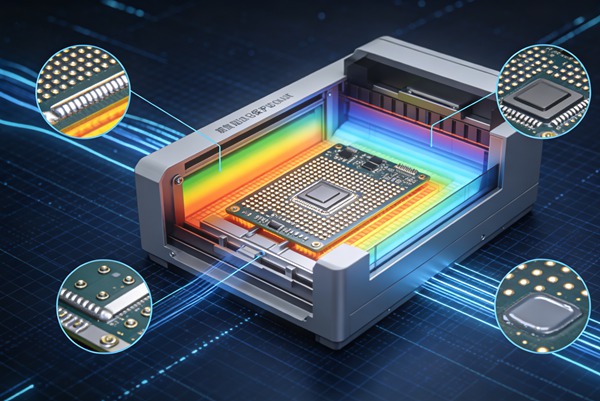
As the electronics manufacturing industry has comprehensively transitioned away from toxic substances, the adoption of lead-free solder alloys has become the global standard. While environmentally responsible and legally mandated by directives such as RoHS (Restriction of Hazardous Substances), the shift to lead-free PCBA (Printed Circuit Board Assembly) introduced significant technical challenges. Chief among these challenges is the deterioration of solder wetting and the increased propensity for rapid oxidation at the higher temperatures required for lead-free reflow.
To overcome these obstacles and maintain the high-reliability standards demanded by modern electronic applications, engineers and manufacturers frequently turn to nitrogen reflow soldering. By replacing the oxygen-rich ambient air inside the reflow oven with an inert nitrogen atmosphere, manufacturers can dramatically improve solder wetting, minimize defect rates, and enhance the overall structural integrity of the solder joints. This comprehensive guide explores the mechanics, advantages, and implementation strategies of nitrogen reflow soldering in lead-free PCBA manufacturing.
Innehållsförteckning
The Challenges Inherent in Lead-Free Soldering
Before understanding the solutions nitrogen provides, it is crucial to understand the problems associated with lead-free solder alloys, such as SAC305 (Tin-Silver-Copper).
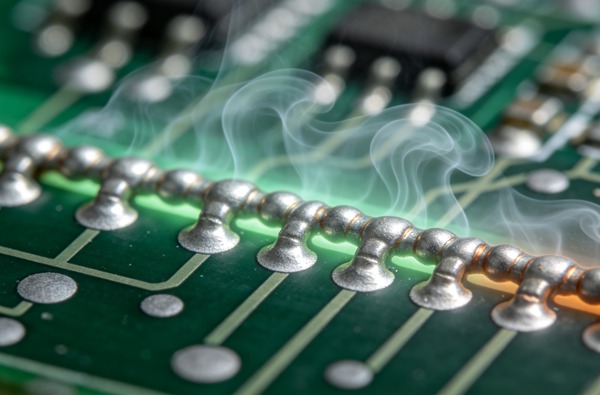
The primary issue is the melting point. Lead-free alloys typically melt at significantly higher temperatures (around 217°C to 220°C) compared to traditional tin-lead solder (which melts at 183°C). Consequently, the peak temperatures in a lead-free reflow profile often exceed 240°C. At these elevated temperatures, the rate of oxidation for the printed circuit board pads, the component leads, and the solder paste itself increases exponentially when exposed to atmospheric oxygen.
Oxidation acts as a physical barrier. When a layer of oxide forms over the metal surfaces, it prevents the molten solder from making direct metallurgical contact with the base metal. This results in poor solder wetting—a phenomenon where the solder fails to spread evenly over the pad, leading to weak, structurally compromised connections.
Furthermore, to combat this aggressive oxidation, solder paste manufacturers formulate lead-free pastes with more aggressive and robust flux chemistries. However, these fluxes must survive the extended pre-heat and soak zones of the reflow profile without exhausting their activation properties before the solder actually melts. If the flux burns off or is rendered inert too early due to excessive oxidation, the resulting solder joint will suffer from severe wetting defects, such as head-in-pillow (HIP) defects or non-wetting opens.
Understanding the Mechanics of Nitrogen in Reflow Soldering
Nitrogen (N2) is an inert gas, meaning it does not readily react with other chemical elements under normal manufacturing conditions. In the context of a surface mount technology (SMT) reflow oven, nitrogen is pumped into the heating chambers to displace the ambient air, effectively creating an oxygen-deprived (or low parts-per-million oxygen) environment.
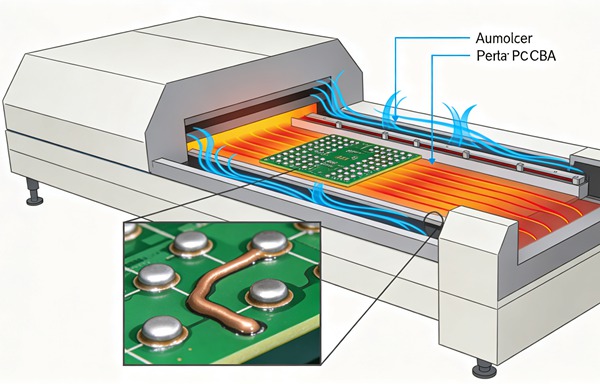
The fundamental mechanic at play is the suppression of oxidation. By removing the oxygen from the equation, the metal surfaces on the PCB—including the copper pads, the component terminations, and the microscopic solder particles within the solder paste—are protected from forming new oxide layers during the critical heating phases of the reflow profile.
When oxidation is suppressed, the solder wetting process is fundamentally transformed. Molten solder inherently possesses high surface tension. In an oxygen-rich environment, the oxide skin that forms on the surface of the molten solder further increases this surface tension, restricting the solder’s ability to flow. In a nitrogen atmosphere, the absence of this oxide skin significantly lowers the surface tension of the molten alloy. This reduction in surface tension allows the lead-free solder to flow more freely, spread more rapidly, and aggressively wet the metallic surfaces of the pads and component leads, creating a robust intermetallic bond. Lär dig mer om Kretskort med samlingsskenor: Integrering av kopparsamlingsskenor för högströmsapplikationer.
Key Advantages of Nitrogen Reflow for Lead-Free PCBA
The introduction of nitrogen into the reflow process yields a multitude of direct benefits that translate to higher manufacturing yields and superior product reliability. Lär dig mer om Glassubstrat i kretskort: Framtiden för högfrekvent IC-förpackning.
Cost-Benefit Analysis and ROI for PCB Manufacturers
Despite the clear technical advantages, implementing nitrogen reflow soldering represents a significant capital and operational expenditure. PCB manufacturers must carefully weigh the costs against the anticipated return on investment (ROI).
The costs involve either retrofitting existing reflow ovens with gas injection systems and oxygen monitors, or purchasing new, nitrogen-capable ovens featuring advanced gas-tight seals. Additionally, there is the ongoing operational cost of the nitrogen supply itself, whether sourced via liquid nitrogen Dewars, bulk delivery tanks, or on-site nitrogen generation plants. Lär dig mer om AXI-röntgeninspektion: Upptäcka defekter i form av PTH-fyllning och sprickor i cylindern.
However, the ROI is often realized rapidly through a substantial reduction in rework and scrap. For high-reliability sectors such as automotive, aerospace, medical devices, and telecommunications, where field failures carry exorbitant financial and reputational penalties, the improved joint integrity provided by nitrogen is considered mandatory rather than optional. Furthermore, as component miniaturization continues (e.g., 01005 passives and ultra-fine-pitch BGAs), the margin for error in the soldering process shrinks. In these high-density applications, the improved wetting and reduced defect rates provided by nitrogen reflow easily justify the associated costs.
How to Implement Nitrogen Reflow Soldering in PCBA (Step-by-Step Guide)
Följ dessa tekniska riktlinjer.
- Drastic Improvement in Solder Wetting
As previously established, the primary advantage is enhanced wetting. The lower surface tension allows the molten solder to wick up component leads and spread across pads with much greater efficiency. This is particularly critical for components with complex or hard-to-solder finishes, and for bare copper boards that are highly susceptible to oxidation.
- Reduction in Voiding
Solder voids—pockets of trapped gas within the hardened solder joint—are a common defect in lead-free assemblies, particularly under large thermal pads like those found on QFN (Quad Flat No-leads) or BGA (Ball Grid Array) components. Excessive voiding compromises both the electrical conductivity and the thermal dissipation capabilities of the joint. Nitrogen reflow expands the process window for the flux, allowing it to efficiently outgas and clear oxides without being overwhelmed, which directly correlates to a reduction in the volume and frequency of solder voids.
- Mitigation of Head-in-Pillow (HIP) Defects
The head-in-pillow defect occurs when a BGA sphere fails to coalesce with the solder paste deposit on the PCB pad, resulting in a connection that resembles a head resting on a pillow. This is often caused by the oxidation of the BGA sphere or the exhaustion of the flux during the reflow profile. By maintaining an inert atmosphere, nitrogen prevents the oxidation of the BGA spheres and preserves the flux’s activity, drastically reducing the occurrence of HIP defects.
- Extended Flux Activation Life
Because the flux does not have to fight a constant battle against newly forming oxides in an inert atmosphere, its chemical efficacy is preserved. This extended flux life allows manufacturers to utilize less aggressive, no-clean solder pastes and affords greater flexibility in designing the thermal profile, particularly for complex boards that require extended soak times to ensure uniform heating.
- Enhanced Cosmetic Appearance
While lead-free solder joints are inherently duller and grainier than their tin-lead counterparts, an air reflow environment often exacerbates this, resulting in highly oxidized, dark, and uneven surfaces. Nitrogen reflow protects the molten solder as it cools and solidifies, resulting in solder joints that are noticeably shinier, smoother, and aesthetically closer to traditional tin-lead joints. This improved appearance also facilitates easier and more accurate Automated Optical Inspection (AOI).
- Assess Your Manufacturing Requirements
Begin by analyzing your current production data. Evaluate if your lead-free assemblies are suffering from unacceptably high rates of poor wetting, excessive voiding, head-in-pillow defects, or cosmetic rejections. Determine if the complexity of your board designs (e.g., heavy copper planes, fine-pitch components) necessitates the expanded process window that nitrogen provides.
- Select the Right Nitrogen Supply Method
Choose a nitrogen supply strategy that aligns with your consumption volume, budget, and facility logistics. Low-volume operations may rely on liquid nitrogen Dewars. Medium to high-volume facilities often opt for bulk liquid nitrogen tanks installed outside the factory. For continuous, high-volume production, investing in an on-site nitrogen generator (using Pressure Swing Adsorption or membrane technology) can provide the most cost-effective long-term solution.
- Upgrade or Configure the Reflow Oven
Ensure your reflow oven infrastructure is fully capable of handling nitrogen. This involves more than just pumping gas into the chamber. You must ensure the oven features high-quality sealing mechanisms (such as specialized input and output curtains) to prevent atmospheric oxygen from leaking in and expensive nitrogen from escaping. Additionally, install closed-loop oxygen monitoring sensors to continuously measure the internal atmosphere.
- Calibrate the Oxygen PPM Levels
Determine and set the target oxygen concentration for your specific process. For standard lead-free PCBA, maintaining oxygen levels between 500 and 1000 parts per million (ppm) generally provides optimal wetting improvements without necessitating excessive gas consumption. For highly complex assemblies or extremely demanding reliability standards, you may need to drive the oxygen concentration down to 100 to 300 ppm.
- Optimize the Thermal Profile
Adjust your reflow thermal profile to account for the new atmospheric conditions. Nitrogen possesses slightly different thermal transfer characteristics than ambient air. More importantly, because the flux is preserved longer in an inert environment, you may need to tweak the duration of the soak zone and the peak temperature to prevent thermal shock to sensitive components while still ensuring optimal flux activation and solder coalescence.
- Monitor and Maintain the System
Implement a strict, regular maintenance schedule. Continuously monitor the oxygen analyzer’s calibration to ensure accurate readings. Routinely inspect the oven’s gas seals and extraction curtains for wear and tear to prevent gas leaks. Finally, track your overall solder joint quality, first-pass yield rates, and nitrogen consumption to ensure the system operates at peak efficiency and delivers the expected ROI.
Transitioning to a nitrogen-assisted reflow process requires careful planning and systematic execution. Follow these steps to ensure a successful implementation. Lär dig mer om Inbränningskort: Blind- och begravda genomgångshål med hög densitet för komponenter med stort antal utgångar.
Ofta ställda frågor (FAQ)
The ideal oxygen level typically ranges from 500 to 1000 ppm for standard lead-free PCBA. However, highly complex boards with fine-pitch components, or applications demanding extreme reliability, may require the oxygen levels to be pushed as low as 100 to 300 ppm to ensure perfect solder wetting and minimal oxidation.
No, nitrogen does not replace the chemical function of flux. Flux is still absolutely necessary to actively reduce and remove the existing oxides that are already present on the PCB pads and component leads prior to entering the oven. Nitrogen’s role is to prevent new oxides from forming during the heating process, which allows the flux to work more efficiently and last longer.
While some standard air reflow ovens can be retrofitted with nitrogen delivery manifolds, it is often technically challenging and economically inefficient to achieve the necessary gas-tight seals required to maintain low oxygen ppm levels. Standard ovens often leak heavily, leading to exorbitant nitrogen consumption costs. Investing in a purpose-built nitrogen-capable oven with engineered seals is generally recommended for optimal results and lower operating costs.
It is not strictly necessary for simple boards featuring large components and basic FR4 substrates. However, for high-reliability applications, complex mixed-technology boards, dense assemblies with fine-pitch BGAs or QFNs, and boards utilizing heavy copper layers, nitrogen is highly recommended—and often mandated—to overcome the inherent wetting challenges of lead-free solder alloys.
Nitrogen reflow typically produces shinier, smoother, and more uniform solder joints compared to air reflow, even when utilizing lead-free alloys. While lead-free joints are naturally duller than traditional tin-lead joints, the inert nitrogen atmosphere prevents severe surface oxidation as the liquid solder cools. This results in a cleaner, more aesthetically pleasing finish that significantly reduces false calls during Automated Optical Inspection (AOI) processes.