Once a project reaches 14 layers, the PCB is no longer just a circuit carrier. At this stage, the board itself becomes part of the signal integrity, thermal, and power distribution strategy.
Most engineers move to a 14 layer PCB because lower-layer stackups can no longer support routing density, reference plane continuity, or EMI requirements without compromising reliability.
This is common in:
- AI accelerator hardware
- FPGA development platforms
- Telecom backplanes
- Embedded computing systems
- Industrial vision equipment
- High-speed networking devices
- Automotive radar systems
Compared with 10 or 12 layer boards, a 14 layer PCB introduces much tighter manufacturing tolerances. Small problems that are manageable on lower-layer designs often become yield or reliability risks once the stackup becomes thicker and more complex.
For additional multilayer fabrication capabilities, you can also explore our Multilayer PCB Manufacturing page.
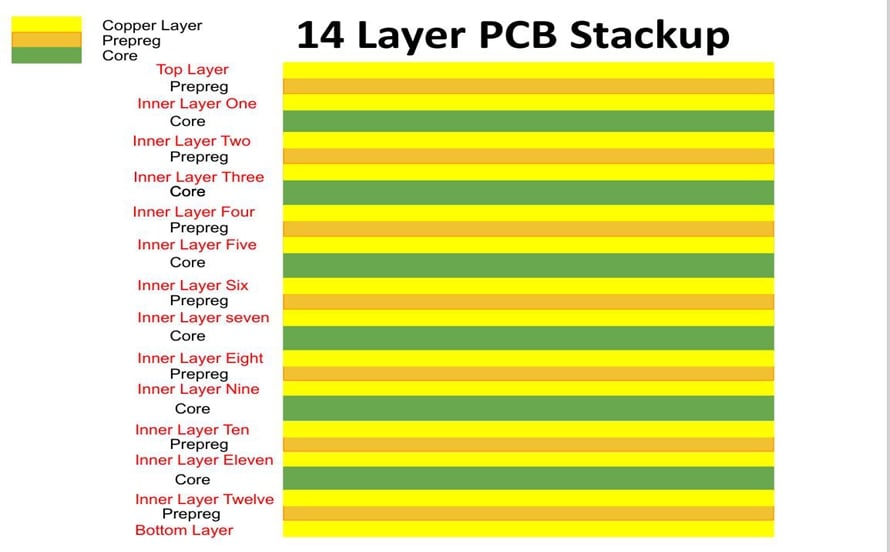
Table of Contents
Why 14 Layer PCBs Are Increasingly Common
Modern electronic systems are pushing routing density much harder than before.
On several recent FPGA and AI projects we reviewed, the issue was not component placement itself, but maintaining stable reference planes while handling dense BGA escape routing and multiple high-speed interfaces simultaneously.
A 14 layer stackup gives engineers more flexibility to separate:
- High-speed signal layers
- Dedicated ground planes
- Power distribution networks
- Sensitive analog sections
- RF structures
- High-current routing areas
This separation improves both signal stability and EMI performance.
In practice, many 14 layer boards are designed not because engineers need “more layers,” but because they need cleaner electrical behavior under higher data rates.
Stackup Planning Becomes a Critical Engineering Decision
At the 14 layer level, stackup planning should happen before layout work begins.
Poor stackup decisions often create problems later such as:
- Impedance instability
- Excessive crosstalk
- Plane resonance
- EMI leakage
- Lamination warpage
- Return path discontinuity
A typical 14 layer PCB stackup may look like this:
| Layer | Function |
|---|---|
| L1 | Signal |
| L2 | Ground |
| L3 | High-Speed Signal |
| L4 | Signal |
| L5 | Power |
| L6 | Ground |
| L7 | Signal |
| L8 | Signal |
| L9 | Ground |
| L10 | Power |
| L11 | Signal |
| L12 | High-Speed Signal |
| L13 | Ground |
| L14 | Signal |
The exact structure depends heavily on:
- BGA density
- Board thickness
- Material type
- Impedance targets
- Thermal requirements
- Via strategy
In actual manufacturing, symmetrical copper distribution is extremely important. Uneven copper balance across 14 layers can easily create twist and bow issues during assembly reflow.
Signal Integrity Problems Become More Difficult to Hide
On lower-layer boards, some routing mistakes may still pass testing without obvious issues.
On 14 layer PCBs running high-speed interfaces, the margin becomes much smaller.
We frequently see problems related to:
- Split reference planes
- Excessive via transitions
- Stub resonance
- Inconsistent differential pair spacing
- Layer-to-layer skew
- Poor return current paths
For PCIe Gen4, DDR4/DDR5, or high-speed SerDes channels, the stackup and routing structure directly affect overall system stability.
Backdrilling is also becoming more common on 14 layer boards because via stubs start creating measurable signal degradation at higher frequencies.
In practical production, impedance control is usually less about calculation formulas and more about maintaining manufacturing consistency across the entire stackup.
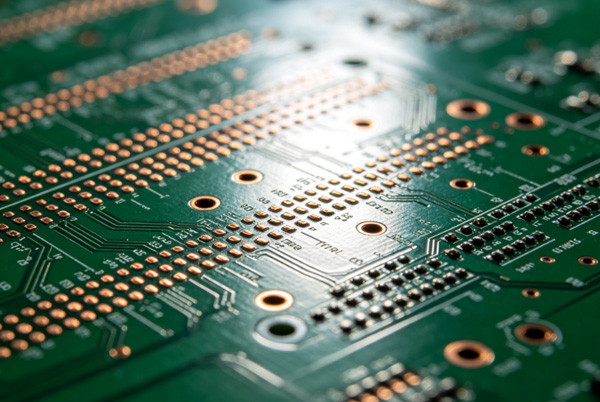
HDI Structures Are Often Necessary on 14 Layer Boards
Large BGAs and dense routing areas often make standard through-hole routing impractical.
As a result, many 14 layer PCB projects introduce:
- Blind vias
- Buried vias
- Via-in-pad structures
- Laser microvias
- Sequential lamination
These technologies improve routing density but significantly increase fabrication complexity.
One common issue is over-aggressiveness via sizing. Engineers sometimes reduce drill sizes too aggressively without considering manufacturing capability or plating reliability.
For thicker multilayer boards, drill aspect ratio becomes a serious reliability factor.
A structure that looks electrically optimized may still create:
- Weak copper plating
- Barrel cracking
- CAF risks
- Registration challenges
- Yield reduction
For advanced technologies, our HDI PCB Manufacturing service page explains additional fabrication capabilities.
Material Selection Directly Affects Reliability
At 14 layers, material behavior becomes much more important than many engineers initially expect.
Multiple lamination cycles, thicker stackups, and higher assembly temperatures all increase stress on the PCB structure.
For industrial and telecom systems, high Tg materials are commonly used to improve dimensional stability during thermal cycling.
For high-speed designs, low-loss materials help reduce insertion loss and signal degradation.
Common material options include:
- FR4 Tg170
- Panasonic Megtron
- Isola low-loss laminates
- Rogers hybrid materials
Material choice affects:
- Z-axis expansion
- CAF resistance
- Delamination resistance
- Impedance consistency
- Drill quality
- Lamination stability
In real production environments, incorrect prepreg combinations often create more reliability problems than routing itself.
Thermal Management Cannot Be Ignored
Many 14 layer boards support processors, FPGAs, AI chips, or power-intensive devices.
As layer count increases, heat dissipation becomes more difficult because thicker PCB structures trap thermal energy more easily.
Thermal management strategies may include:
- Heavy copper areas
- Thermal vias
- Copper balancing
- Dedicated heat spreading layers
- Metal shielding structures
Without proper thermal planning, localized hotspots may create long-term reliability issues even if the board passes initial testing.
Lamination Stability Is One of the Hardest Manufacturing Challenges
A 14 layer PCB requires significantly tighter process control than standard multilayer boards.
The lamination process must control:
- Resin flow
- Layer registration
- Pressure balance
- Heating profile
- Cooling stress
- Material expansion behavior
Even slight process variation may lead to:
- Delamination
- Voids
- Excessive warpage
- Inner-layer misalignment
- Resin starvation
This becomes especially critical on large-format telecom or server boards where mechanical stress increases across the panel.
Several multilayer failures we investigated were ultimately related to lamination imbalance rather than electrical design errors.
How to Improve 14 Layer PCB Reliability
- Build the stackup around signal return paths
Many signal integrity problems originate from interrupted return current paths rather than trace routing itself.
High-speed layers should remain adjacent to continuous ground references whenever possible. - Reduce unnecessary layer transitions
Every via transition introduces discontinuity.
Keeping critical signals on fewer layers often improves performance more than aggressive impedance tuning. - Review the aspect ratio before finalizing the design
Small drill sizes on thick boards may exceed reliable plating capability.
This is especially important for telecom and industrial products with long service life requirements. - Balance copper distribution across all layers
Copper imbalance is a major source of multilayer PCB warpage.
Balancing copper density early in layout usually improves manufacturing stability significantly. - Perform DFM review before Gerber release
At the 14-layer level, DFM review should happen during layout — not after fabrication problems appear.
Critical review points include:
. Drill-to-copper clearance
. Annular ring tolerance
. Resin flow risk
. Impedance manufacturability
. Via reliability
. Copper balancing
. Registration capability
Our PCB Design Service team often supports customers during this optimization stage.
Typical Applications for 14 Layer PCBs
14 layer PCB boards are commonly found in:
- AI computing hardware
- FPGA systems
- Telecom infrastructure
- Industrial automation platforms
- High-speed networking equipment
- Aerospace electronics
- Medical imaging systems
- Automotive radar and ADAS hardware
As data rates continue increasing, more embedded systems are moving toward higher-layer-count PCB architectures to maintain electrical stability.
FAQ
A: Most 14 layer PCBs range from approximately 2.0mm to 3.2mm, depending on stackup design, copper weight, and impedance requirements.
A: Not always. However, many dense BGA applications require blind vias or buried vias to maintain routing efficiency.
A: Uneven copper distribution, poor lamination balance, and improper material selection are among the most common causes.
A: Higher data rates create greater insertion loss, making low-loss materials important for maintaining signal quality.
A: In practical production, lamination stability and registration accuracy are usually among the most difficult process controls.
Conclusion
A 14 layer PCB is typically used when electrical performance, routing density, and long-term reliability all become equally important.
At this level, successful PCB manufacturing depends not only on layout quality but also on stackup planning, material selection, via strategy, and realistic manufacturability considerations.
The most reliable multilayer designs are usually the ones developed with both electrical performance and fabrication capability in mind from the beginning.