Table of Contents
Trace Width and Spacing (The Precision Factor)
Manufacturing costs increase as you push the limits of factory precision.
Advanced (High Cost): Dropping to 3/3 mil or below requires HDI PCB manufacturing processes and LDI (Laser Direct Imaging) technology, which adds a premium to the fabrication price.
Standard (Low Cost): 6/6 mil (0.152mm) trace/space is the industry “sweet spot.”
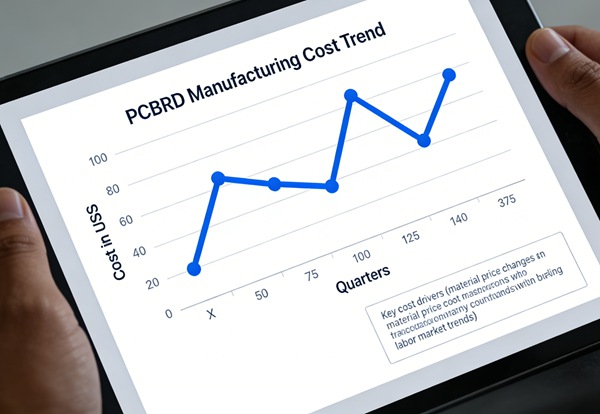
Why PCB Design Has a Major Impact on Cost
A PCB design is not only an electrical blueprint but also a manufacturing instruction. Complex designs require additional processing steps, specialized materials, and tighter quality controls, all of which increase cost.
Key reasons design affects cost:
- Manufacturing complexity increases with design density
- Non-standard specifications reduce production efficiency
- Tight tolerances lower yield and raise inspection costs
Via Types: Through-Hole vs. Blind & Buried
The way you connect layers is one of the biggest cost drivers in modern electronics.
Complex: Blind and buried vias require multiple lamination and drilling cycles. If your design can avoid these by using smarter PCB design principles, you can save up to 40% on total fabrication costs.
Cost-Efficient: Standard through-hole vias drilled mechanically in one pass through the entire PCB stack-up design.
Board Size and Panel Utilization
PCB raw material is sold by the sheet.
- The “Waste” Factor: A slightly smaller board that fits more units on a standard production panel (e.g., 18*24 ) can drastically reduce the cost per piece.
- Optimization: Always consult your manufacturer’s panel size during the initial layout to maximize area efficiency and reduce PCB manufacturing cost.

5 Steps to Design for Lower Manufacturing Costs
- Simplify Your BOM (Bill of Materials)
Reduce the variety of SMD components to minimize pick-and-place machine setup time.
- Stay Within Standard Tolerances
Avoid ultra-tight tolerances (e.g., hole diameter $\pm 0.05\text{mm}$) unless they are strictly necessary for mechanical fit.
- Optimize Routing for Standard Materials
Use PCB design optimization strategies to manage impedance with standard FR-4 instead of expensive high-speed laminates where possible.
- Avoid Internal Cutouts & Slots
Irregular board shapes or internal millings require extra CNC routing time and specialized bits, increasing labor costs.
- Run a Pre-Order DFM Check
Identify “cost-additive” features before they hit the production line at Topfast.
PCB cost FAQ
A: Green is the industry standard and cheapest. Other colors like Black, Red, or Matte finishes may add cost and 1-2 days of lead time due to additional equipment setup.
A: Keep the layer count even (4, 6, 8) and use a balanced PCB stack-up design to prevent board warping, which reduces scrap rates.
A: ENIG uses real gold and a complex chemical process. It provides superior shelf life and planarity for high-end PCB assembly, but the raw material cost is significantly higher.
A: While basic electrical testing is usually included, specialized functional tests or testing capacitors on-site will incur a service fee.
A: Yes. Heavier copper requires more raw material and longer etching times, which increases the total manufacturing budget.

Conclusion
Mastering the relationship between design and cost is the hallmark of an elite engineer. By making informed decisions during the layout phase, you can ensure your product is not only high-performing but also commercially viable for mass PCB assembly.
Ready to see how your design choices affect your quote? Upload Your Gerber Files for a Fast Quote from Topfast today.