Every multilayer PCB is built around two fundamental materials: core and prepreg. While they are rarely visible in the finished product, they play a critical role in determining board thickness, layer spacing, impedance control, mechanical stability, and manufacturing reliability.
Whether producing a simple 4-layer board or a complex high-layer-count backplane, understanding how core and prepreg materials work together is essential for stackup design and PCB fabrication.
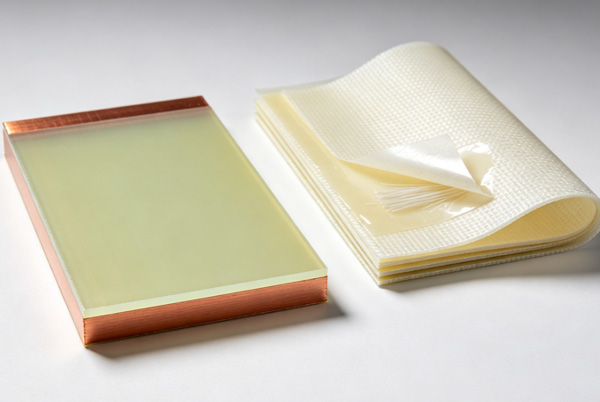
Table of Contents
What Is PCB Core Material?
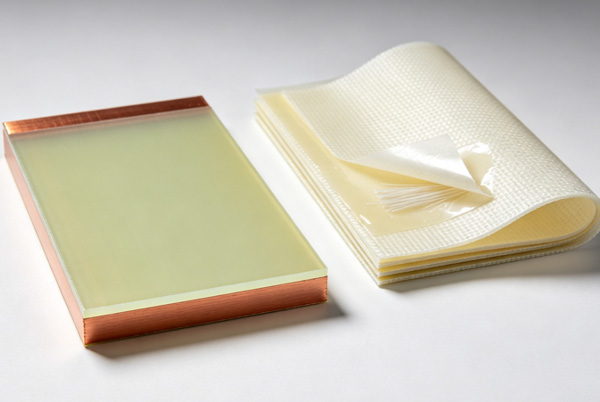
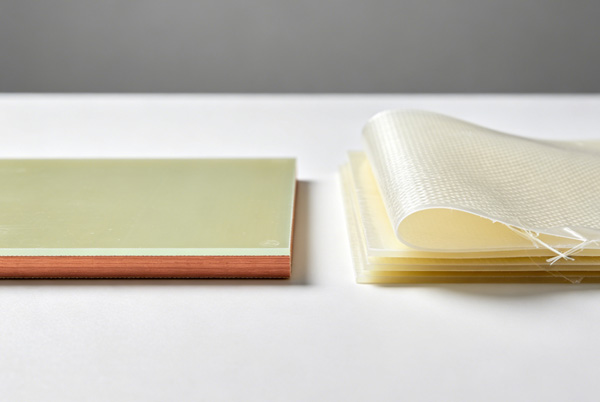
Core material is a fully cured laminate with copper foil bonded to both sides.
It serves as the structural foundation of a multilayer PCB and provides rigidity during fabrication.
A typical core consists of:
- Fiberglass reinforcement
- Resin system
- Copper foil on both surfaces
The construction is similar to standard laminate materials discussed in PCB Laminate Materials Explained, except that the resin has already completed the curing process.
Core materials are available in a wide range of thicknesses to support different stackup requirements.
Functions of Core Material
Core layers provide:
- Mechanical strength
- Electrical insulation
- Copper support
- Dimensional stability
Without cores, multilayer boards would not maintain their structural integrity during lamination and assembly.
What Is PCB Prepreg?
Prepreg stands for “pre-impregnated” material.
It consists of fiberglass cloth impregnated with partially cured resin.
Unlike core material, prepreg remains in a semi-cured state before lamination.
During the PCB lamination process, heat and pressure cause the resin to flow and fully cure, bonding adjacent layers together.
A prepreg layer typically contains:
- Fiberglass cloth
- Partially cured epoxy resin
- No copper foil
Its primary purpose is to create adhesion between core layers.
How Core and Prepreg Work Together
A multilayer PCB is essentially a stack of copper layers separated by cores and prepregs.
For example, a typical 4-layer stackup may look like:
Copper
Core
Copper
Prepreg
Copper
Core
Copper
During lamination:
- The prepreg softens.
- Resin flows into gaps.
- Layers are bonded together.
- The resin fully cures.
- A single rigid structure is formed.
This process creates the multilayer PCB structure used in modern electronics.
Common Core Materials
Standard FR4 Core
The majority of multilayer PCBs use FR4 core materials.
Advantages include:
- Low cost
- Good mechanical strength
- Stable processing characteristics
- Wide availability
For general-purpose electronics, FR4 remains the most widely used option.
Engineers unfamiliar with FR4 properties may refer to FR4 PCB Material Explained for additional background.
High TG Core Materials
Applications involving higher temperatures often use high TG cores.
Benefits include:
- Improved thermal stability
- Reduced Z-axis expansion
- Better reliability during lead-free assembly
These materials are commonly found in:
- Automotive electronics
- Industrial controls
- Power conversion systems
- Servers
As discussed in High TG FR4 PCB, higher TG values can significantly improve long-term reliability.
High-Speed Core Materials
Modern communication equipment frequently uses specialized low-loss cores.
Examples include:
- Megtron series
- Isola high-speed materials
- I-Speed laminates
- Low-loss FR4 systems
These materials help maintain signal integrity at high data rates.
Common Prepreg Types
Prepregs are generally classified by fiberglass style and resin content.
Common fiberglass styles include:
- 106
- 1080
- 2113
- 2116
- 7628
Each style provides different thickness and resin characteristics.
Low Resin Prepreg
Offers:
- Improved thickness control
- Reduced resin flow
- Better dimensional stability
Often used in high-layer-count PCBs.
High Resin Prepreg
Provides:
- Better filling capability
- Improved bonding
- Enhanced dielectric spacing
Typically used where larger copper features are present.
Core and Prepreg in Impedance Control
One of the most important functions of core and prepreg materials is impedance management.
Signal impedance depends on:
- Dielectric constant (Dk)
- Layer spacing
- Copper thickness
- Trace geometry
The thickness of the core or prepreg directly affects the distance between signal layers and reference planes.
Even small changes can significantly impact controlled impedance values.
For this reason, stackup design and material selection must be coordinated from the beginning of the project.
Future discussions on dielectric properties will be covered in Dk and Df Values in PCB Materials.
Material Selection for Multilayer PCBs
Several factors should be considered when selecting core and prepreg materials.
Electrical Performance
Applications involving high-speed signals require stable dielectric properties.
Thermal Requirements
Higher operating temperatures may require high TG systems.
Board Thickness
Core and prepreg combinations determine final PCB thickness.
Manufacturing Capability
Certain materials require specialized lamination profiles and processing controls.
Cost Considerations
Material selection should align with performance requirements rather than using the highest specification available.
Common Challenges During Lamination
Improper material selection can lead to several manufacturing issues.
Resin Starvation
Insufficient resin flow may cause voids or weak bonding.
Excessive Resin Flow
Too much resin movement can alter dielectric spacing and affect impedance.
Delamination
Poor material compatibility may result in layer separation during thermal cycling.
Thickness Variation
Incorrect prepreg selection can lead to inconsistent finished board thickness.
Experienced PCB manufacturers evaluate these factors during stackup development to minimize production risks.
Why Material Compatibility Matters
Core and prepreg materials are often sourced from the same laminate manufacturer.
Matching material systems helps ensure:
- Consistent thermal expansion
- Reliable bonding
- Stable dielectric performance
- Improved manufacturing yield
Using incompatible materials may introduce reliability concerns over the life of the product.
FAQ
A: Core material is fully cured and contains copper foil on both sides. Prepreg is partially cured and acts as the bonding layer during lamination.
A: Yes. Prepreg thickness and dielectric properties directly influence impedance values and signal performance.
A: Yes. Many multilayer stackups use multiple prepreg styles to achieve specific thickness and electrical requirements.
A: Proper resin flow ensures complete bonding between layers and helps prevent voids or delamination.
A: Yes. Prepreg is essential for bonding core layers together during the lamination process.