Printed circuit boards are manufactured using a combination of dielectric substrates, copper foils, prepregs, solder masks, and surface finishes. The choice of materials has a direct impact on electrical performance, thermal stability, mechanical strength, and long-term reliability.
Although FR4 remains the most widely used substrate, many applications require specialized materials to meet higher frequency, temperature, or thermal conductivity requirements. Understanding the role of each material helps engineers select the most suitable stackup for a specific design.
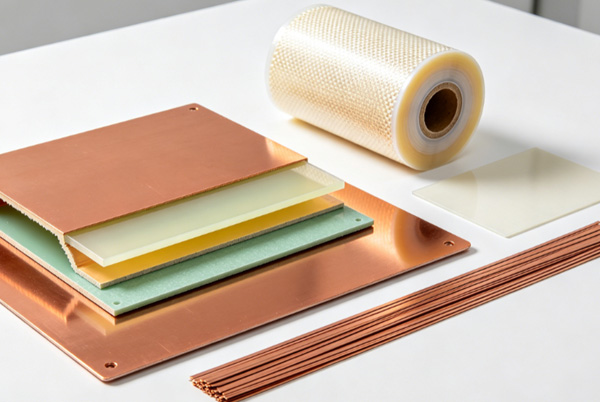
Table of Contents
PCB Substrate Materials
The substrate serves as the structural foundation of the board. It provides mechanical support and electrical insulation between conductive layers.
Several substrate systems are commonly used in PCB fabrication.
FR4
FR4 is the industry standard material for most commercial and industrial electronics. It combines woven glass fiber with epoxy resin, offering good electrical properties and cost efficiency.
Typical applications include:
- Consumer electronics
- Industrial controls
- Communication equipment
- Automotive modules
For standard multilayer boards, FR4 provides a good balance between performance and manufacturing cost.
High TG FR4
High glass transition temperature (TG) materials are preferred when boards are exposed to elevated temperatures or multiple lead-free soldering cycles.
High TG laminates are frequently used in:
- Automotive electronics
- Power supplies
- Servers
- Industrial control systems
Compared with standard FR4, high TG materials exhibit better dimensional stability and moisture resistance.
High-Frequency Materials
RF and microwave applications often require materials with low dielectric constant variation and low dissipation factor.
Common examples include:
- Rogers laminates
- PTFE-based materials
- Taconic materials
- Panasonic Megtron series
These materials are widely used in:
- Radar systems
- 5G communication equipment
- Satellite electronics
- High-speed networking products
Polyimide Materials
Polyimide materials offer excellent thermal resistance and flexibility. They are commonly found in flexible and rigid-flex circuit applications.
Typical industries include:
- Aerospace
- Medical electronics
- Wearable devices
- Military systems
Polyimide boards can withstand harsh environments where conventional FR4 may not be suitable.
Metal Core Materials
Metal core PCBs use aluminum or copper bases to improve heat dissipation.
They are often used for:
- LED lighting
- Power converters
- Automotive lighting
- High-current applications
Aluminum core PCBs remain the most common solution due to their balance between thermal performance and manufacturing cost.
Copper Foil
Copper foil forms the conductive paths that carry electrical signals and power throughout the board.
Common copper weights include:
| Copper Weight | Thickness |
|---|---|
| 0.5 oz | 17 μm |
| 1 oz | 35 μm |
| 2 oz | 70 μm |
| 3 oz | 105 μm |
| 4 oz and above | Heavy copper |
Thicker copper improves current-carrying capability but also affects trace spacing and etching tolerances.
Heavy copper constructions are frequently used in power electronics and industrial equipment.
Core and Prepreg Materials
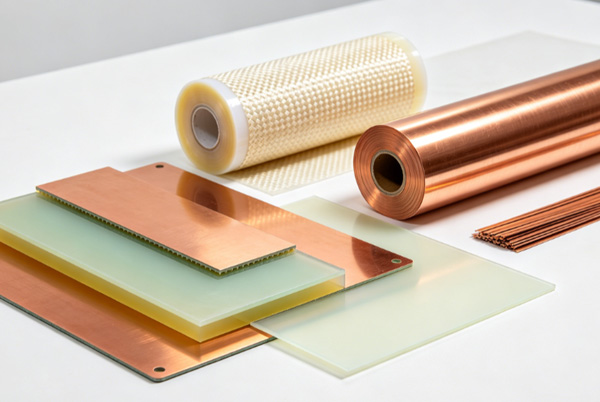
Multilayer PCBs are built using cores and prepregs.
Core Material
A core consists of cured laminate with copper foil on both sides. It provides rigidity and defines layer thickness.
Prepreg
Prepreg contains partially cured resin reinforced with fiberglass cloth. During lamination, heat and pressure bond multiple layers together.
The combination of core and prepreg determines:
- Board thickness
- Impedance control
- Mechanical stability
- Layer spacing
Proper material selection is essential for high-speed designs and impedance-controlled structures.
Solder Mask
The solder mask protects copper traces from oxidation and prevents solder bridges during assembly.
Green remains the most common color, although black, white, blue, and red are also widely available.
Besides cosmetic appearance, solder masks improve:
- Surface insulation
- Moisture resistance
- Chemical resistance
- Reliability during assembly
Surface Finish Materials
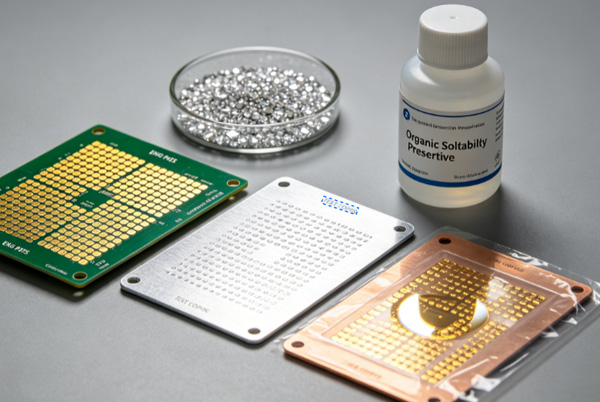
Surface finishes protect exposed copper pads and ensure solderability.
Common finishes include:
ENIG
Electroless Nickel Immersion Gold offers excellent flatness and corrosion resistance, making it suitable for fine-pitch components and BGA packages.
HASL
Hot Air Solder Leveling remains a cost-effective option for conventional assemblies.
Immersion Tin
Immersion tin provides good solderability and is often used in communication and industrial products.
OSP
Organic Solderability Preservative is frequently selected for high-volume consumer electronics due to its low cost.
Material Selection Depends on Application
Different applications place different demands on PCB materials.
| Application | Common Material |
| Consumer electronics | FR4 |
| Automotive electronics | High TG FR4 |
| RF and microwave | Rogers, PTFE |
| Flexible circuits | Polyimide |
| LED products | Aluminum core |
| High-speed servers | Low-loss materials |
| Aerospace systems | Polyimide and ceramic materials |
Material selection should consider several factors simultaneously:
- Operating frequency
- Thermal requirements
- Mechanical stress
- Assembly process
- Cost target
- Long-term reliability
Selecting the right combination of substrate, copper foil, prepreg, solder mask, and surface finish helps ensure stable performance throughout the life cycle of the product.
FAQ
A: FR4 is the most widely used PCB substrate because it offers a good balance between electrical performance, mechanical strength, and manufacturing cost.
A: Rogers laminates provide lower dielectric loss and better signal integrity, making them suitable for RF, microwave, and high-speed applications.
A: Most flexible circuits use polyimide film because of its excellent flexibility and high-temperature resistance.
A: Metal core and ceramic materials offer much higher thermal conductivity than conventional FR4, making them suitable for power and LED applications.
A: Material selection depends on frequency, operating temperature, reliability requirements, mechanical constraints, and overall project cost.