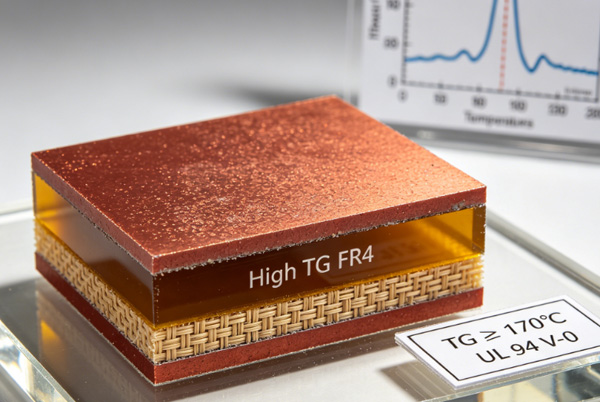
High TG FR4 refers to a class of epoxy glass fiber laminates with an elevated glass transition temperature. In practical PCB manufacturing, TG is one of the key parameters that determines how a board behaves under heat stress, especially during lead-free soldering and long-term high-temperature operation.
Compared with standard FR4, high TG materials offer better structural stability and are widely used in applications where thermal reliability is critical.
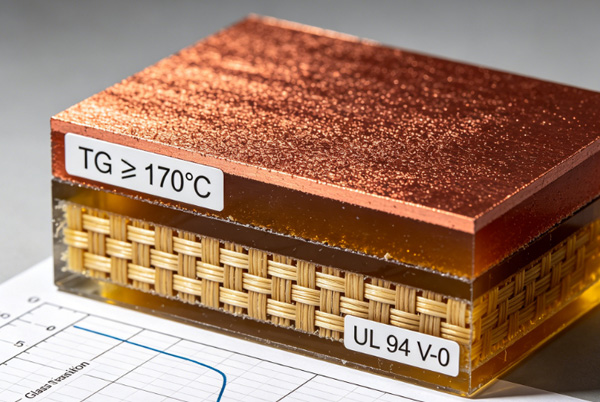
Table of Contents
What TG Means in PCB Materials
TG (glass transition temperature) is the point at which the epoxy resin begins to shift from a rigid, glassy state to a softer, rubber-like state.
Below TG, the material remains stable and mechanically strong. Above TG, the material starts to expand more rapidly and loses rigidity.
For PCB design, this directly affects:
- Dimensional stability
- Via reliability
- Layer alignment
- Long-term mechanical strength
Standard TG vs High TG FR4
FR4 materials are generally divided into three categories:
Standard TG FR4
- TG around 130°C–140°C
- Suitable for general electronics
- Common in low-cost consumer products
Mid TG FR4
- TG around 150°C–160°C
- Balanced performance and cost
- Used in industrial electronics
High TG FR4
- TG ≥ 170°C
- Designed for high thermal stress environments
- Common in high-reliability applications
High TG materials maintain structural integrity during multiple reflow cycles, making them suitable for modern SMT processes.
Why High TG FR4 Matters in PCB Manufacturing
As PCB assemblies become more complex, thermal stress during production and operation has increased significantly.
High TG materials help reduce:
- Resin decomposition during soldering
- Delamination risks
- Via cracking
- Warpage in multilayer structures
They also improve long-term reliability in harsh environments.
Electrical and Mechanical Properties
High TG FR4 generally maintains similar electrical properties to standard FR4, but with improved thermal behavior.
| Property | Typical Range |
|---|---|
| TG | ≥170°C |
| Dielectric constant (Dk) | 4.2–4.7 |
| Dissipation factor (Df) | 0.015–0.020 |
| Thermal expansion (Z-axis) | Lower than standard FR4 |
| Decomposition temperature | ~300°C |
The most important improvement is reduced Z-axis expansion, which directly affects the reliability.
Where High TG FR4 Is Used
High TG FR4 is not required for every product, but it becomes essential when reliability or temperature increases.
Automotive Electronics
Modern vehicles rely heavily on electronic control systems exposed to high under-hood temperatures.
Applications include:
- Engine control units (ECU)
- Power steering systems
- Battery management systems (BMS)
Power Electronics
High TG materials are widely used in:
- Switching power supplies
- Inverters
- Industrial power modules
Communication Systems
Used in:
- Base station boards
- Network infrastructure equipment
- Optical modules
Server and Data Systems
High TG FR4 is commonly found in:
- Server motherboards
- Storage systems
- High-density computing boards
Manufacturing Considerations
Using high TG materials affects PCB fabrication in several ways.
Drilling and Via Reliability
Lower Z-axis expansion improves via barrel reliability during thermal cycling.
Lamination Process
High TG materials often require:
- Higher lamination pressure
- Controlled heating profiles
- Strict resin flow management
Reflow Resistance
Boards must withstand multiple SMT reflow cycles without delamination or blistering.
High TG FR4 vs Standard FR4
| Feature | Standard FR4 | High TG FR4 |
| TG value | 130–140°C | ≥170°C |
| Thermal stability | Moderate | High |
| Cost | Lower | Slightly higher |
| Reliability | General use | High reliability |
| SMT suitability | Basic | Advanced multi-reflow |
The cost difference is relatively small compared to the improvement in reliability.
Limitations of High TG FR4
Although high TG improves thermal performance, it is still based on epoxy resin systems.
Limitations include:
- Higher dielectric loss at high frequencies
- Not suitable for microwave designs
- Limited performance above several GHz
- Thermal conductivity is still relatively low
For RF or ultra-high-speed applications, low-loss materials such as Rogers or Megtron are preferred.
Material Selection Strategy
In real PCB engineering, high TG FR4 is often a “middle ground” solution.
A typical selection logic is:
- Low-cost electronics → Standard FR4
- Industrial / automotive → High TG FR4
- High-speed / RF → Rogers or PTFE
- Ultra-high-speed backplanes → Megtron or Isola high-speed series
Common High TG FR4 Suppliers
Several laminate manufacturers provide widely used high TG materials:
- Shengyi
- Kingboard
- ITEQ
- Isola
- Ventec
Each supplier offers multiple TG grades for different performance and cost requirements.
FAQ
A: Not always. High TG is only necessary when the PCB is exposed to higher thermal stress or multiple reflow cycles.
A: Not significantly. It mainly improves thermal and mechanical reliability rather than high-frequency performance.
A: Typically, materials with TG ≥ 170°C are classified as high TG FR4.
A: Yes, but the cost difference is usually moderate compared to standard FR4.
A: It can be used for moderate high-speed applications, but for RF or very high-speed signals, low-loss laminates are preferred.