Rogers materials have become one of the most widely used laminate families in RF, microwave, aerospace, and high-frequency communication applications. While FR4 remains the dominant choice for general electronics, many designs operating at higher frequencies require tighter control over dielectric properties and lower signal loss than conventional epoxy-based materials can provide.
For engineers working with antennas, RF amplifiers, radar systems, satellite communications, or advanced networking hardware, Rogers materials are often among the first options considered during stackup development.
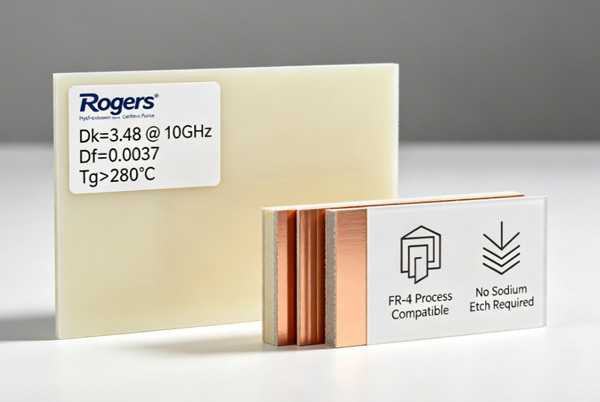
Table of Contents
What Is Rogers PCB Material?
Rogers is a family of high-performance laminate materials developed specifically for applications where electrical performance is critical.
Unlike standard FR4, which primarily uses epoxy resin systems, Rogers materials are formulated using advanced hydrocarbon ceramic or PTFE-based dielectric systems designed to provide:
- Lower dielectric loss
- More stable dielectric constant
- Improved high-frequency performance
- Better impedance consistency
These characteristics make Rogers laminates particularly suitable for RF and microwave circuits.
As discussed in High Frequency PCB Material Selection, dielectric performance becomes increasingly important as operating frequencies rise.
Why Engineers Choose Rogers Materials
The primary advantage of Rogers materials is electrical stability.
In high-frequency circuits, small variations in dielectric properties can directly affect:
- Signal integrity
- Insertion loss
- Phase stability
- Antenna performance
- Filter characteristics
Compared with conventional FR4, Rogers materials offer significantly lower signal attenuation and more predictable electrical behavior.
This becomes especially important in applications where performance requirements leave little room for variation.
Common Rogers Material Families
Over the years, Rogers has introduced multiple laminate families targeting different applications.
Rogers 4350B
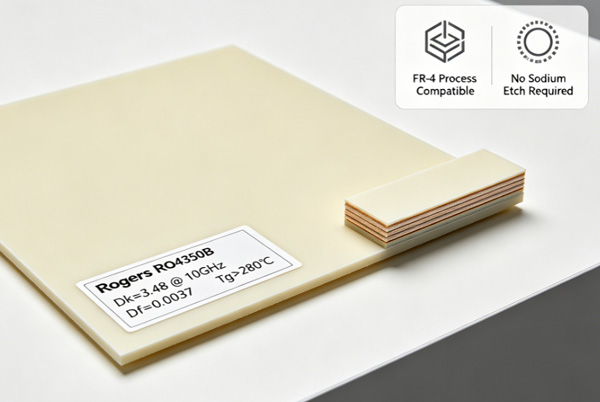
Rogers 4350B is one of the most widely used RF materials in PCB manufacturing.
Typical characteristics include:
- Dk ≈ 3.48
- Df ≈ 0.0037
- Good dimensional stability
- Excellent process compatibility
Applications include:
- RF modules
- Base stations
- Power amplifiers
- Antenna systems
Because it can be processed using fabrication methods similar to FR4, Rogers 4350B remains popular among PCB manufacturers.
A dedicated comparison article covering Rogers 4350B vs Rogers 4003C will explore these differences in greater detail.
Rogers 4003C
Rogers 4003C is another widely adopted hydrocarbon ceramic laminate.
Advantages include:
- Low dielectric loss
- Stable dielectric constant
- Competitive material cost
- Reliable manufacturing performance
It is frequently used in commercial RF products and communication systems.
Rogers 5880
Rogers 5880 is based on PTFE technology and offers extremely low dielectric loss.
Typical applications include:
- Aerospace systems
- Military electronics
- Satellite communications
- Advanced radar platforms
Among Rogers materials, 5880 is often selected when maximizing RF performance is the primary objective.
Rogers vs FR4
One of the most common engineering questions is whether Rogers material is truly necessary.
The answer depends on application requirements.
| Property | FR4 | Rogers |
|---|---|---|
| Dielectric Stability | Moderate | Excellent |
| Signal Loss | Higher | Lower |
| RF Performance | Limited | Excellent |
| Material Cost | Lower | Higher |
| Process Complexity | Simple | Moderate |
For general electronics, FR4 remains a practical and economical choice.
Readers unfamiliar with FR4 fundamentals may refer to FR4 PCB Material Explained.
However, when signal loss or impedance consistency becomes critical, Rogers materials often provide measurable advantages.
Rogers Materials and Dk/Df Performance
One reason Rogers materials are widely used in RF systems is their electrical performance.
Compared with typical FR4 values:
| Material | Dk | Df |
| Standard FR4 | 4.2–4.8 | 0.015–0.025 |
| High TG FR4 | 4.1–4.7 | 0.012–0.020 |
| Rogers 4350B | 3.48 | 0.0037 |
| Rogers 4003C | 3.55 | 0.0027 |
As explained in Dk and Df Values in PCB Materials, lower Df values directly reduce insertion loss and improve signal transmission performance.
This difference becomes increasingly noticeable at microwave frequencies.
Applications of Rogers PCB Materials
Wireless Infrastructure
Rogers laminates are widely used in:
- Cellular base stations
- Microwave backhaul systems
- Wireless networking equipment
Antenna Circuits
Stable dielectric properties help improve antenna efficiency and consistency.
Applications include:
- 5G antennas
- GNSS modules
- Wireless communication products
Radar Systems
Low-loss materials help maintain signal quality in radar applications where performance is highly sensitive to dielectric behavior.
Aerospace Electronics
Aerospace and defense products often rely on Rogers materials for:
- Satellite payloads
- Navigation systems
- Communication equipment
Test and Measurement Equipment
Precision RF testing frequently requires laminates with highly predictable electrical characteristics.
Rogers and Hybrid Stackups
Not every project requires an entire PCB to be fabricated using Rogers material.
Many designs use hybrid constructions that combine:
- Rogers laminates
- FR4 cores
- Standard prepregs
This approach offers several advantages:
- Lower material cost
- Easier fabrication
- Improved overall economics
Hybrid stackups are commonly found in RF products where only specific signal layers require premium materials.
Manufacturing Considerations
Although Rogers materials can often be fabricated using conventional PCB processes, there are important differences compared with FR4.
Factors that require attention include:
Material Handling
Certain Rogers laminates are softer than FR4 and require careful handling during fabrication.
Lamination Profiles
Different resin systems may require modified lamination parameters.
Drilling Performance
Tool selection and drilling conditions may need adjustment depending on the laminate family.
Stackup Design
Proper material selection should be coordinated with core and prepreg construction.
Engineers involved in multilayer design may benefit from reviewing PCB Core and Prepreg Materials when planning hybrid stackups.
Is Rogers Always the Best Choice?
Not necessarily.
Many modern high-speed digital systems use low-loss materials that provide sufficient performance without requiring RF laminates.
Applications such as:
- AI servers
- Data center switches
- Enterprise networking equipment
often use advanced low-loss materials rather than traditional Rogers products.
As discussed in Low Loss PCB Materials Explained, material selection should be based on actual electrical requirements rather than simply choosing the highest-performance option available.
FAQ
A: Rogers materials are commonly used in RF, microwave, aerospace, radar, antenna, and high-frequency communication applications.
A: For high-frequency performance, Rogers generally offers lower loss and better dielectric stability. For general electronics, FR4 is often more cost-effective.
A: The advanced dielectric systems and tighter electrical performance specifications contribute to higher material costs.
A: Yes. Hybrid stackups combining Rogers and FR4 are widely used to balance performance and cost.
A: Rogers 4350B is one of the most commonly specified materials due to its combination of RF performance and manufacturing compatibility.