Rogers 4350B and Rogers 4003C are among the most widely used high-frequency PCB materials in the electronics industry. Both belong to the Rogers RO4000 series and are commonly selected for RF, microwave, wireless communication, aerospace, and networking applications.
Because their electrical characteristics are relatively close, engineers often compare these two materials when evaluating performance, manufacturability, and overall project cost.
Although they share many similarities, there are important differences that can influence material selection.
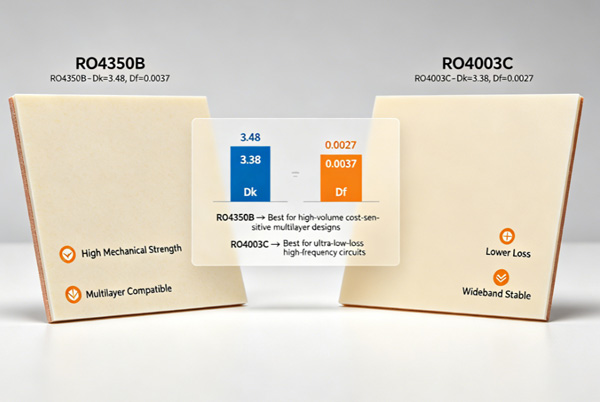
Table of Contents
Understanding the RO4000 Series
The RO4000 family was developed to bridge the gap between conventional FR4 materials and PTFE-based RF laminates.
Compared with PTFE materials, the RO4000 series offers:
- Easier fabrication
- Improved dimensional stability
- Better manufacturing compatibility
- Lower processing complexity
Compared with standard FR4, RO4000 materials provide:
- Lower dielectric loss
- More stable dielectric properties
- Better high-frequency performance
Readers unfamiliar with the Rogers product family may first review Rogers PCB Material for additional background.
Overview of Rogers 4350B
Rogers 4350B is one of the most commonly specified RF laminates worldwide.
Typical material properties include:
| Property | Rogers 4350B |
|---|---|
| Dk (10 GHz) | 3.48 |
| Df (10 GHz) | 0.0037 |
| Thermal Conductivity | 0.69 W/m·K |
| TG | >280°C |
| Moisture Absorption | Low |
Key advantages include:
- Excellent dimensional stability
- Good thermal performance
- Reliable plated-through-hole performance
- Wide industry acceptance
Because of its balanced characteristics, Rogers 4350B is frequently used in both commercial and industrial RF products.
Overview of Rogers 4003C
Rogers 4003C is another hydrocarbon ceramic laminate designed for RF and microwave applications.
Typical properties include:
| Property | Rogers 4003C |
| Dk (10 GHz) | 3.55 |
| Df (10 GHz) | 0.0027 |
| Thermal Conductivity | 0.71 W/m·K |
| Moisture Absorption | Low |
| Process Compatibility | Excellent |
Its lower dielectric loss makes it attractive for designs operating at higher frequencies or requiring longer RF transmission paths.
Rogers 4003C is widely used in:
- Wireless communication systems
- RF modules
- Antenna designs
- Microwave circuits
Electrical Performance Comparison
Electrical characteristics are often the primary reason engineers choose one material over another.
Dielectric Constant
| Material | Dk |
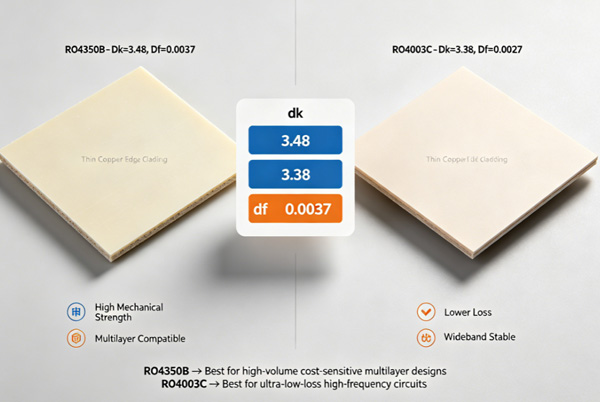
| Rogers 4350B | 3.48 |
| Rogers 4003C | 3.55 |
The difference is relatively small.
In most practical designs, both materials support excellent impedance control and predictable signal behavior.
As discussed in Dk and Df Values in PCB Materials, stable dielectric properties are often more important than the exact Dk value itself.
Dissipation Factor
| Material | Df |
| Rogers 4350B | 0.0037 |
| Rogers 4003C | 0.0027 |
Rogers 4003C offers slightly lower dielectric loss.
For applications involving:
- Higher frequencies
- Longer transmission lines
- More demanding RF requirements
this advantage may become meaningful.
Thermal Performance
Thermal stability is another important consideration.
Both materials perform significantly better than conventional FR4 systems.
Advantages include:
- Improved dimensional stability
- Better reliability under thermal cycling
- Reduced expansion during assembly
For engineers transitioning from standard laminates, the differences become more noticeable in complex multilayer structures.
Those working with conventional materials may benefit from reviewing High TG FR4 PCB to understand how thermal performance affects reliability.
Manufacturing Considerations
One reason the RO4000 family remains popular is its manufacturing compatibility.
Compared with PTFE laminates:
- Drilling is easier
- Lamination is more straightforward
- Copper adhesion is excellent
- Fabrication costs are generally lower
Many PCB manufacturers process Rogers 4350B and 4003C using equipment similar to that used for FR4 production.
This reduces fabrication complexity and helps shorten lead times.
Applications for Rogers 4350B
Rogers 4350B is frequently selected for:
Power Amplifiers
Its thermal stability makes it suitable for RF power applications.
Base Station Equipment
Wireless infrastructure products often use 4350B for reliable RF performance.
Automotive Radar
The material performs well in radar and advanced driver assistance systems.
Mixed RF and Digital Designs
Its manufacturing flexibility makes it attractive for hybrid stackups.
Applications for Rogers 4003C
Rogers 4003C is commonly found in:
Microwave Communication Systems
Lower dielectric loss supports improved signal transmission.
Antenna Circuits
Stable electrical characteristics help maintain predictable antenna behavior.
Satellite Communication Equipment
Low loss and reliable RF performance are important in aerospace environments.
Precision RF Modules
Many RF front-end modules use 4003C to minimize signal attenuation.
Hybrid Stackups with FR4
In many products, only a portion of the PCB requires RF-grade materials.
Designers often create hybrid stackups combining:
- Rogers 4350B or 4003C
- FR4 cores
- Standard prepregs
This approach offers:
- Lower material cost
- Simplified fabrication
- Better overall project economics
Hybrid constructions are commonly used in communication products that contain both RF and digital circuitry.
For more information about stackup construction, see PCB Core and Prepreg Materials.
Which Material Should You Choose?
The answer depends on design priorities.
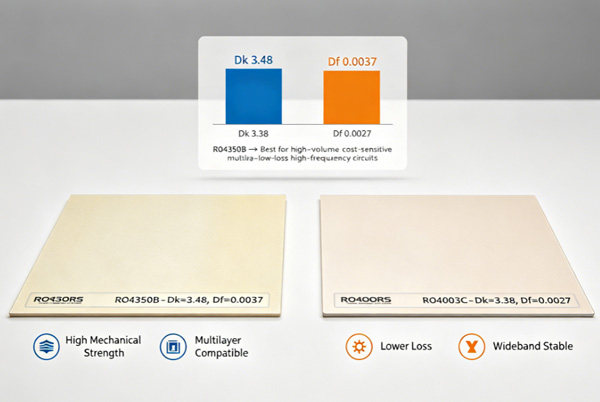
Rogers 4350B is often selected when:
- Thermal stability is important
- Manufacturing flexibility is desired
- Proven industry adoption is preferred
Rogers 4003C is often selected when:
- Lower dielectric loss is required
- RF performance is the primary objective
- Signal attenuation must be minimized
In many cases, either material can successfully meet project requirements.
The final decision is often influenced by:
- Frequency range
- Stackup requirements
- Availability
- Cost targets
- Manufacturing preferences
FAQ
A: The primary differences are dielectric constant and dissipation factor. Rogers 4003C offers slightly lower loss, while Rogers 4350B is often preferred for its thermal stability and broad industry adoption.
A: Rogers 4003C generally has a lower dissipation factor than Rogers 4350B.
A: Yes. Rogers 4350B is widely used in RF and microwave circuits, including antennas, amplifiers, and wireless infrastructure.
A: In many applications, yes. However, the final decision should be based on electrical, thermal, and manufacturing requirements.
A: Yes. Both materials offer lower dielectric loss and more stable electrical properties than standard FR4.