FR4 has been the standard material for printed circuit boards for decades. Its combination of electrical performance, mechanical strength, and affordability makes it suitable for everything from simple consumer products to complex multilayer boards.
Although many specialized laminates are available today, FR4 remains the first choice for most PCB designs because it provides a good balance between reliability and manufacturing cost.
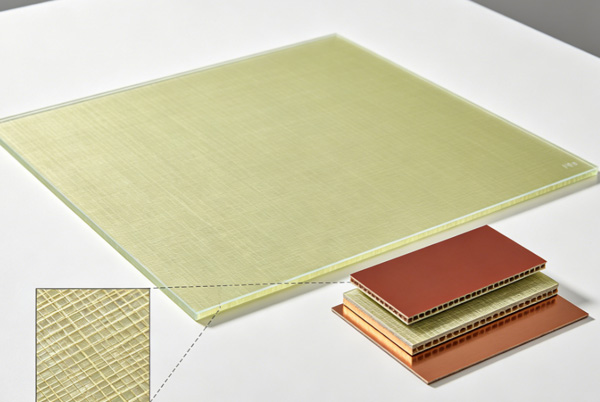
Table of Contents
What FR4 Means
FR stands for flame retardant, while the number 4 refers to the classification defined by the NEMA standard.
FR4 is made from woven fiberglass cloth impregnated with epoxy resin. After curing under heat and pressure, the material forms a rigid insulating substrate capable of supporting copper layers and electronic components.
The material offers:
- Good mechanical strength
- Stable electrical properties
- Excellent insulation
- Moisture resistance
- Low manufacturing cost
These characteristics explain why FR4 dominates the PCB industry.
How FR4 Is Used in PCB Manufacturing
FR4 serves as the dielectric material between copper layers.
Typical structures include:
Single-Sided Boards
Used in:
- Power adapters
- Household appliances
- LED products
Double-Sided Boards
Common in:
- Industrial controllers
- Automotive electronics
- Communication equipment
Multilayer Boards
Widely used for:
- Servers
- Medical devices
- Networking equipment
- Embedded systems
Modern multilayer boards with 4 to 20 layers are commonly built using FR4 laminates and prepregs.
Common FR4 Material Properties
Although specifications vary between manufacturers, standard FR4 materials usually have the following characteristics.
| Property | Typical Value |
|---|---|
| Dielectric constant (Dk) | 4.2–4.8 |
| Dissipation factor (Df) | 0.015–0.025 |
| Glass transition temperature | 130–170°C |
| Thermal conductivity | 0.3–0.4 W/m·K |
| Volume resistivity | >10¹² Ω·cm |
| Flame rating | UL94 V-0 |
These values are suitable for most low-speed and medium-speed electronic products.
Standard TG and High TG FR4
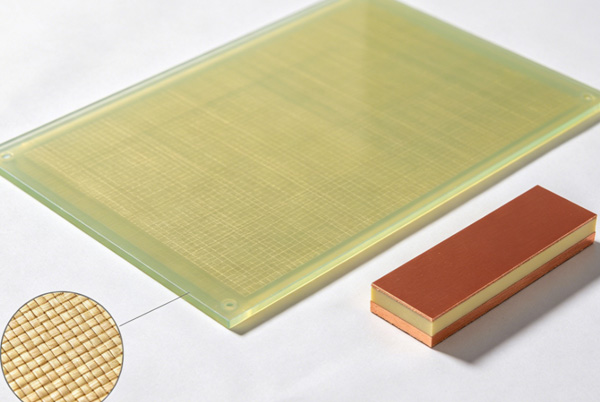
One important parameter of FR4 is the glass transition temperature (TG).
Standard TG Materials
Typical TG values range from 130°C to 140°C.
Applications include:
- Consumer electronics
- Home appliances
- General industrial products
High TG Materials
High TG laminates usually have values above 170°C.
They provide better performance under:
- Lead-free assembly
- High operating temperatures
- Multiple reflow cycles
High TG materials are commonly found in:
- Automotive electronics
- Power supplies
- Servers
- Telecommunications equipment
Internal link: High TG FR4 PCB
Advantages of FR4
Several factors make FR4 the industry’s most widely used substrate.
Cost Efficiency
FR4 is significantly less expensive than RF laminates and specialty materials.
Mature Manufacturing Process
Virtually every PCB manufacturer supports FR4 fabrication.
Mechanical Stability
The fiberglass structure provides excellent rigidity and dimensional stability.
Wide Availability
Major suppliers such as Shengyi, Kingboard, ITEQ, and Isola offer numerous FR4 product families.
Suitable for Most Applications
For frequencies below several gigahertz, FR4 usually meets electrical requirements without excessive cost.
Limitations of FR4
Despite its versatility, FR4 is not suitable for every application.
Higher Signal Loss
Compared with low-loss laminates, FR4 exhibits higher dielectric loss at high frequencies.
Limited Thermal Conductivity
Heat dissipation performance is relatively poor.
Dk Variation
Dielectric constant changes with frequency and manufacturing conditions, which may affect impedance consistency.
Not Ideal for RF Applications
Microwave and millimeter-wave designs often require specialized materials.
Popular FR4 Material Brands
Several laminate manufacturers dominate the market.
Shengyi
Widely used in Asia and known for stable quality.
Kingboard
One of the largest PCB laminate suppliers worldwide.
ITEQ
Frequently used for networking and industrial applications.
Isola
Popular in North America and high-reliability products.
Ventec
Provides high-speed and thermal management materials.
Different manufacturers offer equivalent grades, allowing engineers to optimize cost and supply chain flexibility.
Typical Applications of FR4
FR4 boards are found in almost every electronic industry.
Consumer Electronics
- Smart devices
- Home appliances
- Power adapters
Industrial Equipment
- PLC systems
- Inverters
- Automation controllers
Automotive Electronics
- Body control modules
- Sensors
- Infotainment systems
Medical Devices
- Monitoring equipment
- Portable instruments
Communication Products
- Routers
- Switches
- Network modules
Unless high frequency or extreme temperatures are involved, FR4 remains a practical and economical choice.
When FR4 Is No Longer Enough
As data rates and frequencies continue to increase, engineers often encounter the limitations of conventional FR4.
Applications such as:
- 5G infrastructure
- High-speed servers
- Radar systems
- RF modules
may require materials with:
- Lower dielectric loss
- More stable Dk values
- Improved thermal performance
In these cases, Rogers, PTFE, Megtron, and other low-loss materials become more suitable options.
FAQ
A: Not exactly. FR4 is a composite material made from fiberglass cloth and epoxy resin. The fiberglass provides strength, while the resin provides insulation.
A: Most FR4 materials have a dielectric constant between 4.2 and 4.8, depending on frequency and resin system.
A: FR4 works well for many medium-speed applications. Extremely high-speed or RF circuits may require low-loss materials.
A: High TG FR4 refers to materials with a glass transition temperature above 170°C, providing improved thermal stability.
A: Major suppliers include Shengyi, Kingboard, ITEQ, Isola, and Ventec.