PCB performance starts long before traces are routed or components are assembled. The laminate selected for a circuit board determines its electrical behavior, thermal stability, mechanical strength, and manufacturing reliability.
Although many engineers casually refer to all PCB materials as “FR4,” the reality is far more complex. Modern PCB fabrication uses a wide range of laminate systems designed for different operating environments, frequencies, temperatures, and reliability requirements.
Understanding laminate materials helps designers make better decisions during stackup planning and material selection.
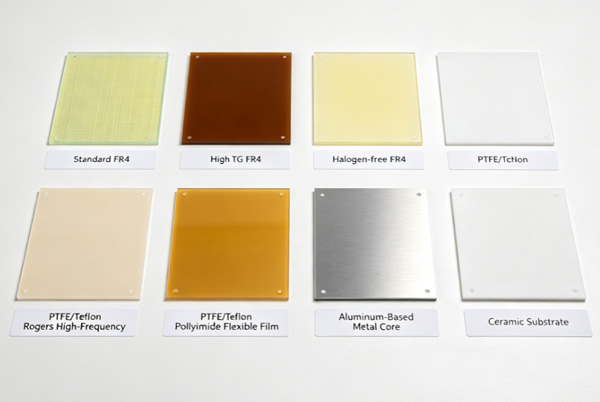
Table of Contents
What Is a PCB Laminate?
A PCB laminate is a composite material formed by combining reinforcement materials with resin systems under heat and pressure.
The laminate serves as the insulating structure that supports copper circuitry throughout the board.
Most laminates consist of:
- Reinforcement material
- Resin system
- Copper foil
Together, these materials create the mechanical and electrical foundation of a PCB.
As discussed in our article on What Materials Are Used in PCB Manufacturing, laminates represent only one part of the complete PCB material system, but they have the greatest influence on overall board performance.
The Main Components of a PCB Laminate
Reinforcement Materials
The reinforcement provides mechanical strength and dimensional stability.
Common reinforcement materials include:
- Woven fiberglass cloth
- Non-woven glass fiber
- Polyimide film
- Ceramic fillers
Fiberglass remains the most widely used option because of its balance of strength, cost, and processability.
Resin Systems
The resin binds the reinforcement together and provides electrical insulation.
Common resin types include:
- Epoxy
- Polyimide
- PTFE
- Cyanate ester
- Hydrocarbon ceramic blends
The resin system largely determines:
- Dielectric properties
- Thermal resistance
- Moisture absorption
- Reliability
Copper Foil
Copper foil is bonded to the laminate surface to form conductive circuitry.
Different copper types can influence:
- Signal loss
- Fine-line capability
- High-current performance
Copper selection becomes increasingly important in high-current and high-speed applications.
FR4 Laminates
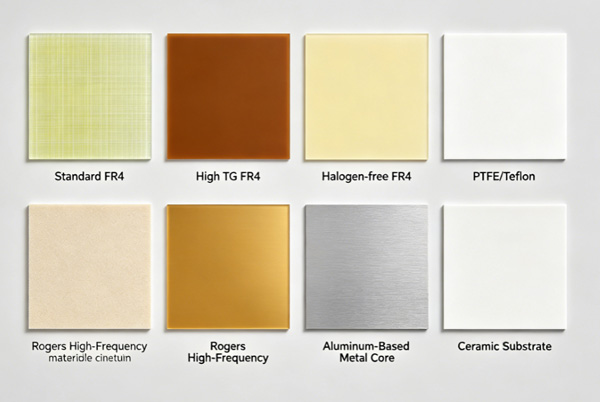
FR4 remains the dominant laminate family in PCB manufacturing.
The material combines woven glass cloth with flame-retardant epoxy resin to create a versatile and economical substrate.
Common applications include:
- Consumer electronics
- Industrial control systems
- Communication equipment
- Medical devices
For most standard multilayer designs, the properties of FR4 are more than sufficient.
Readers unfamiliar with FR4 fundamentals may first review our article on FR4 PCB Material Explained before exploring advanced laminate options.
High TG Laminates
As operating temperatures increase, conventional FR4 materials may reach their limits.
High TG laminates provide improved resistance to:
- Thermal cycling
- Delamination
- Board warpage
- Multiple lead-free reflow processes
These materials are commonly found in:
- Automotive electronics
- Industrial power systems
- Networking hardware
- Server platforms
In many modern multilayer designs, high TG materials have become the preferred choice for reliability-focused applications.
For a detailed discussion of thermal performance, see High TG FR4 PCB.
Low-Loss Laminates
Signal integrity requirements have changed dramatically over the last decade.
High-speed digital systems now operate at data rates that make standard FR4 losses increasingly difficult to manage.
Low-loss laminates offer:
- Lower dissipation factor
- Improved signal quality
- Reduced insertion loss
- Better impedance consistency
They are widely used in:
- Data center equipment
- High-speed networking
- AI servers
- Telecommunications infrastructure
These materials bridge the gap between standard FR4 and specialized RF laminates.
PTFE and RF Laminates
RF and microwave applications require materials with extremely stable dielectric characteristics.
PTFE-based laminates provide:
- Very low dielectric loss
- Stable dielectric constant
- Excellent high-frequency performance
Common applications include:
- Radar systems
- Satellite communications
- RF amplifiers
- Antenna circuits
Rogers and Taconic materials are among the most recognized solutions in this category.
These materials will be examined in more detail in upcoming articles covering Rogers laminates and PTFE PCB materials.
Polyimide Laminates
Polyimide laminates are designed for environments where thermal performance and flexibility are critical.
Advantages include:
- High operating temperature capability
- Excellent chemical resistance
- Good dimensional stability
- Long service life
They are frequently used in:
- Aerospace electronics
- Military systems
- Flexible circuits
- Medical equipment
Compared with FR4, polyimide materials generally offer higher reliability under extreme conditions.
Ceramic-Based Laminates
Ceramic-filled laminates provide improved thermal conductivity and electrical performance.
Applications include:
- High-power electronics
- RF systems
- Automotive power modules
- LED lighting
Ceramic materials are particularly attractive when heat dissipation becomes a design limitation.
How Laminate Selection Affects PCB Performance
The laminate influences several critical design parameters.
Signal Integrity
Dielectric constant and loss tangent directly affect signal quality.
Thermal Reliability
Material stability determines how the board behaves under heat stress.
Manufacturing Yield
Certain materials require specialized drilling, lamination, and handling processes.
Cost
Material choice is often one of the largest contributors to overall PCB fabrication cost.
The most expensive material is not always the best option. The objective is to match material performance to actual application requirements.
Choosing the Right Laminate
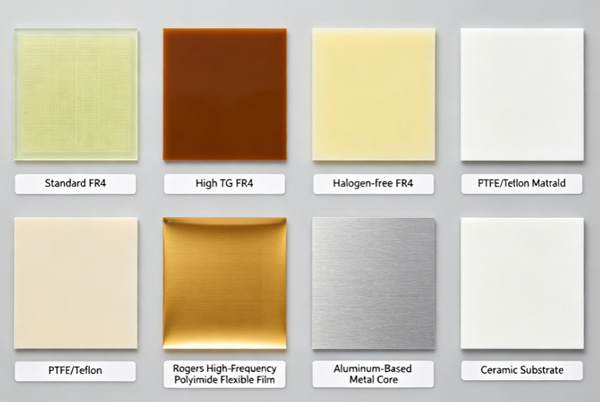
Material selection should be based on engineering requirements rather than marketing specifications.
Questions that should be considered include:
- What operating frequency will the circuit use?
- What temperatures will the board experience?
- Is impedance control required?
- How many assembly cycles are expected?
- What is the target product lifespan?
Answering these questions early helps prevent unnecessary material costs while maintaining reliability.
FAQ
A: In PCB manufacturing, the terms are often used interchangeably. Technically, a laminate refers to the composite material itself, while the substrate refers to its role as the board’s base material.
A: Yes. FR4 is the most common laminate used in PCB fabrication.
A: PTFE-based materials and specialized RF laminates such as Rogers are commonly used for high-frequency applications.
A: They reduce signal attenuation and help maintain signal integrity in high-speed digital and RF designs.
A: No. Many multilayer boards combine different laminate systems to achieve specific electrical, thermal, and cost objectives.