Modern telecommunication systems depend heavily on high-performance PCB manufacturing.
Applications such as:
- networking equipment
- base stations
- communication modules
- data transmission systems
require PCBs capable of maintaining stable electrical performance at high frequencies and high data rates.
Unlike standard consumer electronics, telecommunication PCBs require strict control over signal integrity, impedance, and manufacturing consistency.
Choosing the right PCB factory is essential for ensuring communication stability and long-term product reliability.
If you’re evaluating manufacturing capability: PCB Factory Capabilities Explained

Table of Contents
Why Telecommunication PCBs Are More Complex
Telecommunication systems process high-speed signals that are highly sensitive to manufacturing variation.
Main technical challenges
- signal integrity
- impedance consistency
- electromagnetic interference (EMI)
- multilayer complexity
Small manufacturing deviations can significantly affect system performance.
Key Requirements for a Telecommunication PCB Factory
Controlled Impedance Manufacturing
Controlled impedance is one of the most important requirements for telecom PCBs.
Why it matters
- maintains signal integrity
- reduces transmission loss
- improves high-speed performance
Impedance variation can lead to unstable communication signals.
High Multilayer Manufacturing Capability
Telecommunication PCBs often require complex multilayer structures.
Common requirements
- high layer counts
- dense routing
- precise layer alignment
Manufacturing accuracy becomes increasingly important as complexity increases.
Stable Material Selection
Material stability directly affects signal performance.
Common material considerations
- dielectric constant consistency
- low signal loss
- thermal stability
High-frequency applications often require specialized materials.
Precision Etching and Trace Control
Signal quality depends heavily on trace accuracy.
Important process factors
- line width control
- spacing consistency
- copper uniformity
Process control: Etching Process and Yield Control
Signal Integrity and EMI Management
Telecommunication systems must minimize signal interference.
Manufacturing considerations
- grounding structures
- stackup optimization
- isolation control
Poor EMI management can reduce communication performance.
Advanced Inspection and Testing
High-speed boards require stricter testing procedures.
Common inspection methods
- AOI inspection
- impedance testing
- electrical testing
Testing helps ensure stable signal performance.
Engineering and DFM Support
Engineering review is critical for telecom PCB production.
Includes
- stackup planning
- impedance analysis
- routing optimization
DFM guide: PCB Design for Manufacturing Guidelines
Typical Telecommunication PCB Applications
Telecommunication PCBs are widely used in:
- routers and switches
- RF communication systems
- base station equipment
- fiber optic communication systems
- wireless infrastructure
These applications require highly stable electrical performance.
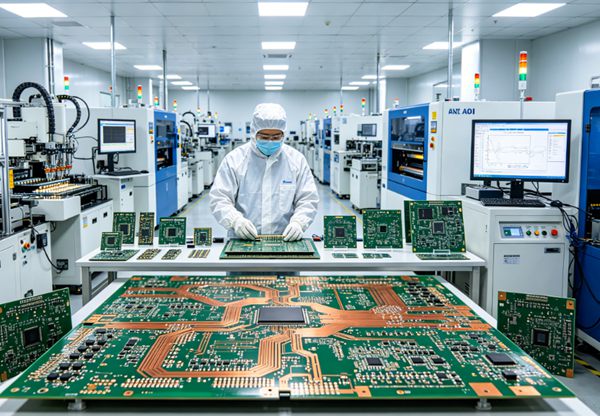
Common Risks in Telecommunication PCB Manufacturing
Impedance inconsistency
Can affect signal transmission quality.
Poor layer alignment
May reduce high-speed performance.
Material instability
Can increase signal loss.
Inadequate EMI control
May create communication interference.
How to Evaluate a Telecommunication PCB Factory
- Step 1 — Verify controlled impedance capability
Ask about:
. impedance tolerance
. testing methods
. stackup control - Step 2 — Review multilayer manufacturing capability
Complex telecom boards require precise layer registration.
- Step 3 — Evaluate engineering support
High-speed PCB manufacturing requires technical collaboration.
- Step 4 — Review inspection systems
Check support for:
. impedance testing
. AOI
. electrical verification - Step 5 — Assess production consistency
Stable manufacturing reduces signal variability.
Why Manufacturing Precision Matters in Telecom PCBs
In telecommunication systems, manufacturing precision directly affects:
- signal quality
- transmission stability
- network reliability
Even small deviations may impact high-frequency performance.
Because of this, telecom customers prioritize manufacturing consistency and engineering capability over low pricing.
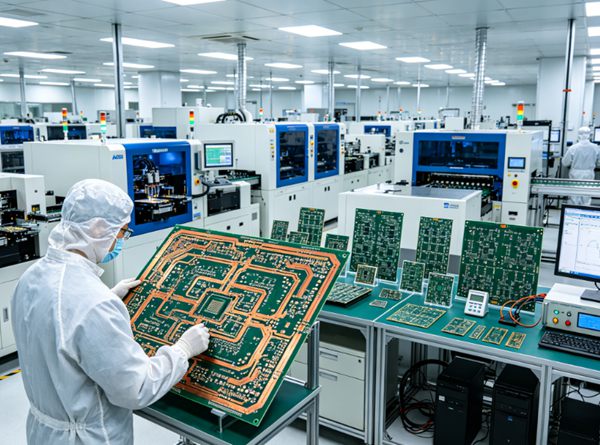
Real Manufacturing Perspective
Telecommunication PCB manufacturing requires precise process control, impedance stability, and consistent multilayer production capability.
At manufacturers such as TOPFAST, telecom-related PCB projects are supported through controlled impedance manufacturing, engineering review, precision process management, and inspection systems to help ensure stable high-speed performance.
Conclusion
Telecommunication PCB manufacturing requires advanced multilayer capability, controlled impedance processes, and stable production consistency.
Choosing a PCB factory with strong engineering support, precision manufacturing capability, and comprehensive inspection systems is essential for ensuring reliable communication performance and long-term product stability.
For telecom applications, manufacturing precision is one of the most critical factors for product success.
FAQ
A: Controlled impedance helps maintain signal integrity and stable high-speed transmission.
A: Low-loss and thermally stable materials are commonly used for high-frequency applications.
A: Telecommunication systems require dense routing and complex signal structures.
A: AOI, impedance testing, and electrical verification are commonly used.
A: No, telecom PCB manufacturing requires precise impedance control and multilayer capability.