Not all PCB manufacturing focuses on mass production.
Many industries require:
- multiple product types
- small production batches
- rapid engineering updates
- flexible manufacturing capability
This manufacturing model is commonly called:
High-Mix Low-Volume (HMLV)
HMLV PCB manufacturing is widely used in:
- industrial electronics
- medical equipment
- aerospace systems
- customized electronic products
Unlike high-volume production, HMLV manufacturing prioritizes flexibility, engineering responsiveness, and production adaptability.
Choosing the right PCB factory is essential for maintaining efficiency and quality in complex production environments.
If you’re evaluating general manufacturing capability: PCB Factory Capabilities Explained

Table of Contents
What Is High-Mix Low-Volume PCB Manufacturing?
HMLV manufacturing refers to producing:
- many different PCB designs
- relatively small quantities for each design
Typical characteristics
- frequent product changeovers
- varied PCB specifications
- shorter production runs
- complex scheduling requirements
Factories supporting HMLV production must be highly flexible.
Why HMLV Manufacturing Is More Challenging
Compared with standard mass production, HMLV manufacturing creates additional operational complexity.
Main challenges
- rapid setup changes
- engineering coordination
- material management
- production scheduling
Maintaining quality consistency across many product variations is one of the biggest challenges.
Key Requirements for a High-Mix Low-Volume PCB Factory
Flexible Manufacturing Systems
HMLV production requires factories to adapt quickly to different product types.
Important capabilities
- rapid line setup
- flexible scheduling
- small-batch optimization
Factories designed only for mass production may struggle with HMLV efficiency.
Strong Engineering Support
Engineering teams play a critical role in HMLV manufacturing.
Common engineering tasks
- DFM analysis
- stackup review
- process optimization
- manufacturability troubleshooting
Engineering responsiveness directly affects production speed.
DFM guide: PCB Design for Manufacturing Guidelines
Efficient Production Changeover Management
Frequent product switching increases manufacturing complexity.
Key requirements
- fast setup procedures
- standardized workflows
- operator coordination
Poor changeover management reduces efficiency and increases error risk.
Stable Quality Control Across Multiple Products
Different PCB designs require consistent quality management.
Important inspection systems
- AOI inspection
- electrical testing
- process monitoring
Quality systems must remain stable despite frequent production variation.
Quality reference: How PCB Factories Control Quality
Material and Inventory Management
HMLV manufacturing often involves many material types.
Common challenges
- inventory tracking
- material availability
- supplier coordination
Effective material management helps reduce delays.
Fast Prototype and Iteration Capability
Many HMLV projects require rapid design iteration.
Important support areas
- quick engineering feedback
- fast prototype turnaround
- production flexibility
Lead time guide: PCB Lead Time Explained
Traceability and Documentation
Complex projects require accurate production records.
Includes
- material tracking
- revision management
- process documentation
Traceability improves manufacturing control and issue resolution.
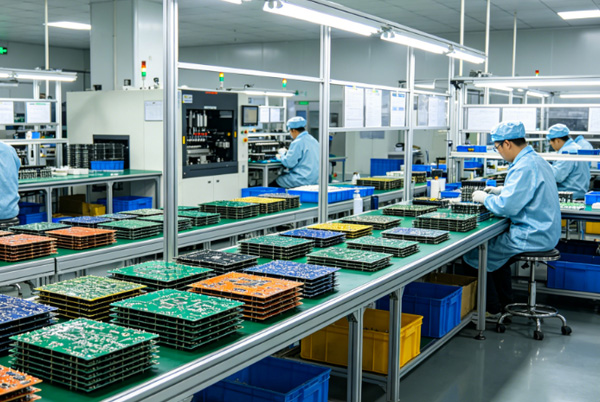
Typical Applications for HMLV PCB Manufacturing
High-mix low-volume PCB manufacturing is commonly used in:
- industrial automation
- medical electronics
- aerospace systems
- research equipment
- customized electronic devices
These industries often require flexible production rather than mass manufacturing.
Common Risks in HMLV PCB Manufacturing
Production scheduling conflicts
Can delay delivery timelines.
Engineering communication gaps
May create manufacturing errors.
Frequent setup variation
Can affect consistency and yield.
Weak inventory management
May lead to material shortages.
How to Evaluate a High-Mix Low-Volume PCB Factory
- Step 1 — Review manufacturing flexibility
Check support for:
. multiple PCB types
. small production batches
. rapid product switching - Step 2 — Evaluate engineering responsiveness
HMLV projects often require close technical collaboration.
- Step 3 — Review quality systems
Consistent inspection processes are critical.
- Step 4 — Assess prototype turnaround capability
Fast iteration improves product development speed.
- Step 5 — Review production management systems
Efficient scheduling and traceability improve operational reliability.
Why Flexibility Matters More Than Pure Capacity
In HMLV manufacturing, production flexibility is often more important than maximum output volume.
Factories focused only on large-scale production may struggle with:
- rapid product changes
- engineering updates
- small-batch efficiency
Because of this, HMLV customers often prioritize flexibility, communication, and engineering support over pure manufacturing scale.
Real Manufacturing Perspective
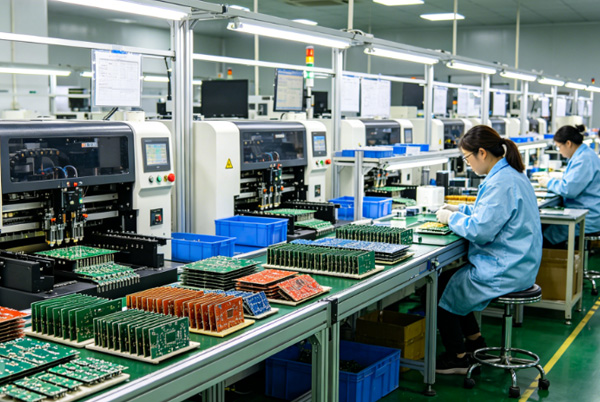
High-mix low-volume PCB manufacturing requires flexible production workflows, strong engineering coordination, and stable quality management.
At manufacturers such as TOPFAST, HMLV PCB projects are supported through engineering review, rapid process coordination, flexible production scheduling, and controlled quality systems to help maintain efficient and reliable manufacturing performance.
Conclusion
High-mix low-volume PCB manufacturing requires much more than basic production capability.
Factories supporting HMLV projects must provide:
- flexible manufacturing systems
- strong engineering support
- stable quality control
- efficient scheduling management
Choosing a PCB factory with proven HMLV capability helps improve production efficiency, reduce engineering risks, and support faster product development cycles.
In complex electronic manufacturing, flexibility and responsiveness are often as important as production capacity itself.
FAQ
A: It refers to producing many different PCB types in relatively small production quantities.
A: Because it involves frequent product changes, varied specifications, and rapid production adjustments.
A: Industrial, medical, aerospace, and customized electronics industries commonly use HMLV manufacturing.
A: Frequent product variation requires fast DFM review and manufacturing optimization.
A: Maintaining quality consistency while managing multiple product variations.
A: Not always. Mass-production factories may struggle with flexibility and rapid changeovers.
A: Review manufacturing flexibility, engineering responsiveness, quality systems, and scheduling capability.