Table of Contents
Introduction to Conformal Coating in PCB Assembly
In the realm of high-reliability printed circuit board assembly (PCBA), protecting the intricate web of traces, vias, and delicate surface-mount technology (SMT) components is not merely an option, but a strict engineering mandate. Conformal coating is a thin, polymeric film applied directly to the PCBA surface, contouring precisely to its unique topography. By conforming to the complex geography of the assembled board, these specialized dielectric materials provide a robust defensive barrier against a wide array of environmental stressors that could otherwise induce catastrophic hardware failures.
Without adequate protection, printed circuit boards deployed in demanding environments—such as automotive under-hood systems, aerospace avionics, marine electronics, and industrial control systems—are highly susceptible to premature degradation. Moisture ingress, for instance, can lead to the formation of conductive anodic filaments (CAF) or dendritic growth between adjacent conductors, ultimately causing catastrophic short circuits. Dust and particulate matter can accumulate on the board, trapping moisture and accelerating localized corrosion while also causing signal degradation in high-frequency circuits. Corrosive gases, salt spray, and extreme thermal cycling further compromise the physical integrity and electrical performance of the assembly by degrading solder joints and oxidizing exposed copper. Conformal coating effectively mitigates these risks, lowering the total cost of ownership, extending the operational lifespan, and ensuring the functional reliability of mission-critical electronics in the field. Learn more about Ceramic PCBs: Alumina vs. Aluminum Nitride (AlN) Ceramic PCBs for Extreme Heat.
Understanding Conformal Coating Materials
Selecting the appropriate conformal coating material requires a rigorous analysis of the operating environment, the desired level of protection, and the specific manufacturing constraints of the PCBA facility. The IPC-CC-830 standard provides the baseline requirements for qualification and performance of conformal coating materials. Engineering teams must evaluate the chemical, mechanical, and electrical properties of various resin systems to specify the optimal solution.
Acrylic Coatings (AR)
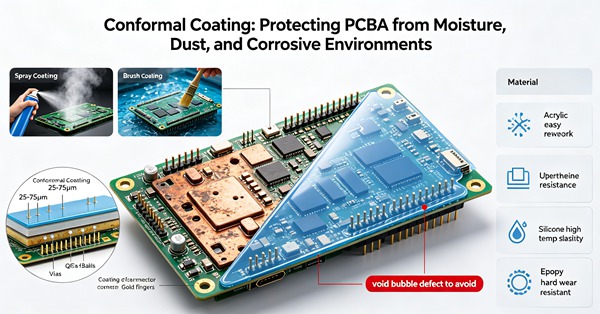
Acrylic resins (AR) are among the most widely utilized conformal coatings across the electronics industry due to their excellent balance of cost-effectiveness, ease of application, and straightforward reworkability. They provide a formidable barrier against moisture, high humidity, and fungus growth. Furthermore, acrylics exhibit favorable dielectric properties and do not undergo excessive shrinkage during the curing phase, minimizing mechanical stress on the board. Because they are typically solvent-based, they cure relatively quickly as the solvent evaporates into the atmosphere. Their primary disadvantage is limited chemical resistance; they are readily dissolved by aggressive solvents, making them unsuitable for environments where chemical exposure is a significant risk. However, this same solubility makes them exceptionally easy to remove using standard solvents for component repair or replacement, reducing rework time and costs.
Silicone Coatings (SR)
For applications subject to extreme temperature fluctuations and high thermal stress, silicone resins (SR) are often the optimal choice. Silicones maintain their flexibility and elastomeric properties over a remarkably broad temperature range (typically -55°C to +200°C), preventing the coating from cracking, crazing, or peeling under severe thermal cycling conditions. They also deliver outstanding moisture and humidity resistance, making them ideal for automotive engine control units (ECUs) and outdoor telecommunications infrastructure. The high flexibility of silicone helps to absorb mechanical shock and vibration, mitigating stress on fragile component leads and fine-pitch solder joints. Their main drawbacks include relatively poor abrasion resistance, a susceptibility to solvent absorption, and the potential for outgassing of low-molecular-weight siloxanes, which must be carefully managed in sensitive optical, relay, or vacuum environments to prevent contact failure.
Polyurethane Coatings (UR)
Polyurethane (UR) coatings are specified when exceptional chemical resistance and mechanical durability are paramount. They form a highly cross-linked, tough film that provides superior protection against harsh solvents, aviation fuels, mild acids, alkalis, and other aggressive chemicals. This robust mechanical profile also translates to excellent abrasion and wear resistance. Polyurethanes provide excellent moisture mitigation and maintain high dielectric strength even in challenging environments. The primary trade-off for this durability is a significant reduction in reworkability. Stripping polyurethane requires harsh, specialized chemical solvents or aggressive mechanical abrasion, which can easily damage the underlying PCB substrate or adjacent components. Curing times can also be extensive, although heat or UV acceleration can optimize the process in a production setting.
Epoxy Coatings (ER)
Epoxy coatings (ER) offer the highest level of mechanical strength and chemical resistance among standard liquid conformal coatings. Often formulated as two-part systems requiring precise mixing, epoxies cure into a rigid, nearly impenetrable barrier. They are virtually impervious to most solvents, harsh industrial chemicals, and severe mechanical abrasion. Epoxies provide excellent humidity and moisture resistance and are frequently utilized in highly corrosive industrial environments, agricultural electronics, or deep-sea marine applications. However, their extreme rigidity can be detrimental during thermal cycling, potentially stressing or fracturing delicate SMT components or glass-bodied diodes due to a mismatch in the coefficient of thermal expansion (CTE). Once cured, epoxy is virtually impossible to remove chemically; rework typically requires highly localized thermal parting or micro-abrasive blasting.
Parylene Coatings (XY)
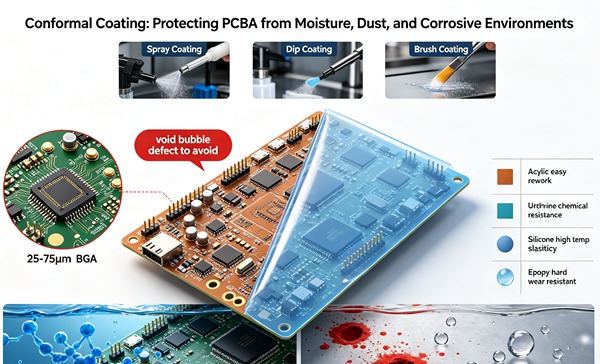
Parylene (XY) represents a distinct and highly specialized class of conformal coating. Unlike liquid resins, Parylene is applied via a chemical vapor deposition (CVD) process under strict vacuum conditions. The resulting film is highly uniform, pinhole-free, and perfectly conformal, effectively penetrating microscopic crevices and shadowing underneath components with exceptionally low stand-off heights, such as BGAs or CSPs. Parylene boasts superior dielectric properties, excellent chemical and moisture resistance, and minimal mass addition to the assembly. It provides the ultimate protection for the most critical medical implants, aerospace sensors, and high-frequency military electronics. The primary constraints of Parylene are the specialized, expensive capital equipment required, high batch-processing costs, and the extreme complexity of masking procedures and potential rework.
Advanced Application Methodologies
The efficacy of a conformal coating is highly dependent on the precision and repeatability of its application. Engineering teams must evaluate the production volume, coating material viscosity, and board complexity when selecting an application method.
Manual Brushing and Dipping
While rudimentary, manual brushing remains a viable technique for low-volume prototyping, touch-up work after rework, or highly specialized localized coating. It requires significant operator skill and consistent technique to achieve a uniform thickness and avoid introducing air bubbles or particulate contaminants. Dip coating involves immersing the entire PCBA into a temperature-controlled bath of coating material. It offers high throughput and excellent, uniform coverage, including penetration beneath components. However, it mandates extensive, labor-intensive masking of connectors, switches, and other keep-out zones. The viscosity and specific gravity of the coating bath must be strictly monitored to maintain consistent film thickness and prevent issues like edge-pulling or pooling during withdrawal. Learn more about M-SAP Technology: Achieving Sub-25 Micron Line/Space for Next-Generation Electronics.
Automated Selective Coating
Automated selective coating has become the industry standard for medium to high-volume electronic manufacturing services (EMS). This technology utilizes programmable robotic multi-axis dispensers to apply liquid coating material only to specific, predefined areas of the PCBA, eliminating or drastically reducing the need for costly and labor-intensive masking and de-masking operations. Selective coating machines employ various applicator valves—such as airless film coaters, atomizing spray valves for larger areas, and needle dispensers for fine details—to achieve precise edge definition and targeted material deposition. Advanced systems integrate fiducial recognition cameras, barcode tracking, and laser height sensing to compensate for board warpage dynamically and ensure consistent application parameters across every unit.
Curing and Cross-Linking Mechanisms
The transition of the conformal coating from a liquid state to a solid, highly cross-linked protective film is a critical phase in achieving the desired physical and electrical properties.
Evaporative and Moisture Cure
Many acrylic and some specific silicone coatings cure primarily through solvent evaporation. While the board may become “tack-free” and safe to handle relatively quickly, achieving a full cure and optimal protective properties may take several days at room temperature. Moisture-cure systems, particularly specific polyurethanes and silicones, rely on ambient humidity to initiate the cross-linking chemical reaction. These systems typically require strictly controlled environmental conditions (temperature and relative humidity) within the manufacturing facility to ensure reliable and repeatable curing profiles.
Thermal Curing
Thermal curing utilizes elevated temperatures, typically achieved in an inline convection oven or IR reflow system, to drastically accelerate the curing process of polyurethanes, epoxies, and many silicones. Heat dramatically reduces cycle times, improving manufacturing throughput and reducing WIP. However, thermal engineers must carefully profile the oven to prevent solvent entrapment—which causes blistering or micro-voids—and ensure the maximum internal temperature does not exceed the thermal limits of the PCBA components or the glass transition temperature of the substrate.
Ultraviolet (UV) Curing
UV-curable coatings, often based on complex acrylated urethanes or specially formulated epoxies, have revolutionized high-volume conformal coating operations. These materials polymerize and cure almost instantaneously (often within seconds) upon exposure to specific wavelengths of high-intensity ultraviolet light. This eliminates the need for massive curing ovens and minimizes work-in-progress inventory, freeing up valuable floor space. A common engineering challenge with UV curing is “shadowing”—areas beneath tall components or underneath component bodies where UV light cannot directly penetrate. Modern UV coatings address this by incorporating a secondary curing mechanism, typically a moisture or thermal cure, to ensure that shadowed, unexposed areas still cross-link fully over time.
How to Apply Conformal Coating (Step-by-Step Guide)
Follow these engineering rules. Learn more about Precision Impedance Control: How to Achieve ±5% Impedance Tolerance in High-Speed PCBs.
- Board Cleaning and Preparation
The PCBA must be completely free of all flux residues, particulate contamination, oils, fingerprints, and moisture prior to coating application. Surface contaminants can significantly impede adhesion, promote blistering during cure, or trap corrosive ionic elements beneath the protective film. Utilize an automated inline aqueous cleaner, semi-aqueous system, or vapor degreaser, followed by a rigorous thermal baking cycle to ensure the board is entirely desiccated and ready for optimal adhesion.
- Masking Keep-Out Zones
Identify and rigorously protect areas where conformal coating is strictly prohibited by the design specification. This includes gold-plated connectors, RF test points, electromechanical switches, open vias, heat sinks, and specific sensitive components. Masking can be achieved using specialized low-residue polyimide tapes, precision pre-formed silicone boots, or liquid peelable temporary solder masks. Ensure all masking materials are chemically compatible with the specific coating chemistry and the subsequent curing process.
- Coating Application
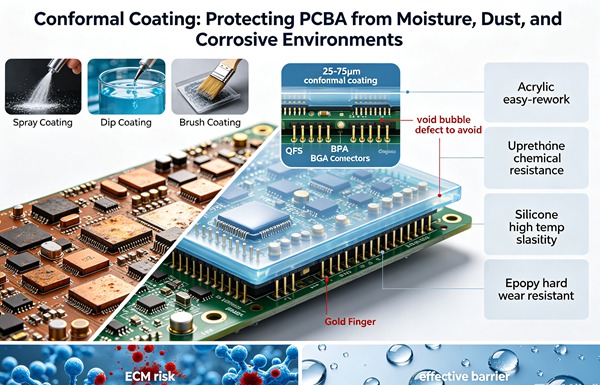
Apply the properly selected conformal coating material using the specified methodology (automated selective robotic dispensing, controlled dipping, or precise spraying). The engineering team must maintain strict statistical process control (SPC) over parameters such as fluid pressure, atomization air pressure, valve travel speed, and dispense height to ensure a uniform film thickness within the target specification (typically 25 to 75 microns for liquid coatings, as strictly defined by IPC standards).
- Curing Process
Process the freshly coated PCBA through the appropriate curing mechanism based on the coating chemistry. For UV systems, ensure the UV dosage (combining energy density and peak irradiance) meets or exceeds the material manufacturer’s requirements. For thermal systems, continuously verify the oven profile to prevent thermal shock, outgassing, or blistering. For moisture or ambient cure systems, transfer the boards to a controlled staging area with regulated humidity levels.
- De-masking and Final Inspection
Carefully and methodically remove all tapes, boots, or peelable masking materials immediately after the boards are tack-free or fully cured, depending on the specific masking type utilized. Perform a comprehensive, documented inspection of the entire assembly under long-wave ultraviolet (UV-A) light, as most modern conformal coatings contain a fluorescent tracer dye to verify coverage.
Achieving a flawless, highly reliable conformal coating layer requires strict adherence to a controlled, repeatable process. Below is the standard operating procedure for PCBA conformal coating application. Learn more about Skew Compensation: Managing Fiber Weave Effect (FWE) and Length Matching for PCIe Gen 6.
Advanced Inspection and Quality Assurance
Ensuring the integrity, uniformity, and proper thickness of the conformal coating layer is just as critical as the application process itself. The IPC-A-610 standard provides highly specific acceptability criteria for conformal coating coverage, thickness, and workmanship.
Automated Optical Inspection (AOI)
Modern Conformal Coating AOI (CC-AOI) systems are absolutely essential for high-reliability electronics manufacturing. These specialized machines utilize dedicated UV lighting arrays and high-resolution optical cameras to detect the fluorescent tracer embedded within the coating. Sophisticated CC-AOI algorithms automatically inspect for critical defects, including insufficient coverage on leads, excessive thickness (pooling), micro-bubbles, voids, foreign object debris (FOD), and catastrophic coating ingress into restricted keep-out zones like connector housings.
Thickness Measurement
Accurate verification of the dried film thickness is vital for ensuring long-term reliability. Destructive testing using micro-sectioning provides the highest level of accuracy but is typically reserved for initial process characterization, validation, or failure analysis. Non-destructive methods are strongly preferred for daily production environments. Eddy current probes can accurately measure coating thickness over conductive copper planes, while advanced ultrasonic thickness gauges provide reliable, repeatable measurements over a wider range of FR-4 substrates and complex component geometries without damaging the assembly.
Frequently Asked Questions (FAQ)
Moisture trapped beneath the conformal coating can lead to severe reliability issues. It can dissolve ionic contaminants present on the board surface, creating a conductive electrolytic solution. Under applied voltage, this can result in electrochemical migration, dendritic growth, and eventual catastrophic short circuits between adjacent traces or component leads. Trapped moisture can also vaporize during thermal cycling or reflow, causing the coating to delaminate or blister, thereby destroying the protective barrier entirely.
Yes, PCBA repair and rework are certainly possible, but the difficulty and required techniques depend significantly on the type of coating chemistry used. Acrylics can be relatively easily removed with the targeted application of specific chemical solvents. Silicones and polyurethanes typically require more aggressive mechanical scraping, brushing, or specialized chemical strippers. Epoxies and Parylene are highly resilient, heavily cross-linked structures and generally necessitate highly localized micro-abrasive blasting or thermal parting techniques to expose the underlying solder joints for component replacement. After rework, the localized area must be thoroughly cleaned and re-coated to restore protection.
Coating thickness is verified using specific metrology tools and must align with the IPC-A-610 specifications or customized customer requirements (typically 25-75 microns for acrylics, urethanes, and epoxies; 50-210 microns for silicones; and 12-50 microns for Parylene). During active production, non-destructive tools like eddy current or ultrasonic gauges are used by quality control personnel to spot-check thickness. Additionally, properly calibrated selective coating machines ensure consistent volumetric material dispensing, which directly correlates to the final expected dried film thickness.
Masking is required whenever there are specific “keep-out” zones on the PCBA that must remain completely uncoated for mechanical or electrical functionality (e.g., connector pins, switches, test points, or specific RF shielding). The use of highly precise automated selective coating machines drastically reduces the need for manual masking compared to dip or broad-spray methods. This is because the robotic machine can be programmed to precisely dispense coating only where needed, intelligently avoiding the designated keep-out areas with sub-millimeter accuracy.
The vast majority of commercially available liquid conformal coatings are formulated with a specialized UV fluorescent tracer dye mixed into the resin. When exposed to long-wave ultraviolet light (typically UV-A around 365nm), this tracer fluoresces, usually emitting a bright blue or white visible glow. This feature is a critical mechanism for quality control, allowing human operators and automated CC-AOI systems to easily verify complete and continuous coating coverage, identify missed areas on component leads, and detect application defects like pooling, webbing, or bubbles.